
Travis County 72-Hour Release Reality
The Travis County Sheriff's Office offers a current inmate search, not a three-day release archive. Its public details can include a booking number, facility, booking date, arresting agency, charges, bonds, courts, sentence data, and charge dispositions. No official page promises a rolling 72-hour filter, a post-release retention term, or a fixed refresh interval.
A three-day working window is still useful. It lets a reader check Friday through Sunday events together or revisit a court action after offices reopen. Yet the window is a method of organizing evidence, not an official feed. Central Booking and the Travis County Correctional Complex are one county system, so a move between them remains Travis County custody.
Check Travis County Three-Day Releases
Build a dated log for the whole period. A name search, a court event, and a jail movement record answer different questions. The full person-specific path appears on the Travis County released-inmate search, while this process concentrates on reconciling events across three days.
- Search current TCSO custody and record the exact check time. A match establishes county custody at that update.
- Search Texas VINE for the person and verify Travis County as the agency before relying on a status event.
- Check felony matters through the District Clerk and misdemeanors through the County Clerk for bond, dismissal, sentence, capias, or release orders.
- Request the TCSO booking sheet and final release, book-out, or transfer event for the three-day date range.
- Follow any receiving agency named in the movement record. TDCJ, BOP, USMS, and ICE each maintain separate custody systems.
Keep event time separate from observation time. A record viewed Monday may report a Saturday book-out. Saturday is the custody event; Monday is only the verification date. When sources conflict, compare identifiers, timestamps, and custody scope before drawing a conclusion.
Travis County Three-Day Record Fields
No official 72-hour list supplies a standard field set. The following fields form an accurate substitute when assembled from the jail event and court record.
| Field | Use over a three-day review |
|---|---|
| Booking number | Keeps separate jail stays and same-name people apart. |
| Book-out date and time | Places the recorded custody change inside or outside the review window. |
| Release or transfer disposition | Separates community release from another-agency custody. |
| Facility movement | Prevents a downtown-to-Del Valle move from being mislabeled release. |
| Court and cause number | Connects the event to an order, judgment, bond, or dismissal. |
| Receiving agency | Directs the next check when confinement continues elsewhere. |
A disposition on one charge does not settle every charge or hold. Request the final event and reconcile all active cases before describing the outcome. A bond order supports the legal basis, but the book-out shows what the jail recorded as happening.
The release type also changes the conclusion. Bond ends confinement for that booking while the case continues. Time served ties the departure to sentence credit or completion. Dismissal may end one case while another hold remains. A transfer closes the Travis County custody episode without returning the person to the community. Deceased is a custody termination and must never be described as release. These distinctions belong in any three-day event log.
Travis County Weekend Record Lag
The Travis County Clerk says misdemeanor case data update about every 24 hours and new document images may take about 72 hours. Those figures describe court data. They do not describe sheriff release-feed retention, nor do they prove that a person stayed in jail until an image appeared.
A signed order may precede final jail processing. Another hold can prevent departure after one case is resolved. Conversely, an affirmative weekend book-out may be visible before the related court image. Compare the TCSO event with the court basis after both are available.
The District Clerk handles felony and district matters, while the County Clerk handles misdemeanors. City ordinance and Class C cases may belong in a municipal court. Choosing the correct clerk avoids mistaking an empty search for a missing case.
Travis County Archive Beats Guesswork
The TCSO incarceration-record request is the concrete archival fallback. It covers May 1988 to the present and costs $15. Pickup is offered at 5555 Airport Boulevard, Austin, from 8:00 a.m. to 4:00 p.m. on weekdays other than county holidays. Government photo identification is required, and another person's record requires the authorization set out by TCSO.
A tailored open-records request can seek the booking sheet, book-in and book-out timestamps, release or transfer disposition, releasing authority, receiving agency, and releasable bond, hold, and movement fields. Ask for existing records. The Texas Public Information Act does not require the sheriff to prepare a narrative or answer a research question.
Precision is especially useful when the three-day window contains more than one jail event. Include the full name and aliases, date of birth if lawfully known, booking number, and a narrow date range. Ask for electronic delivery and a cost estimate when appropriate. The most useful wording seeks the “final release or transfer date/time and release/transfer disposition.” That request targets the recorded event without asking staff to draw a conclusion.
TCSO describes ten business days as a response point under the public-information process, not a universal delivery date. Redaction, clarification, cost handling, or an Attorney General ruling can extend the work. Juvenile, sealed, expunged, investigative, medical, and protected identity material may be withheld. Those limits affect disclosure, but they do not justify substituting a current-roster no-result for an affirmative release record.
Review the official incarceration-record request page before submitting identification and payment.
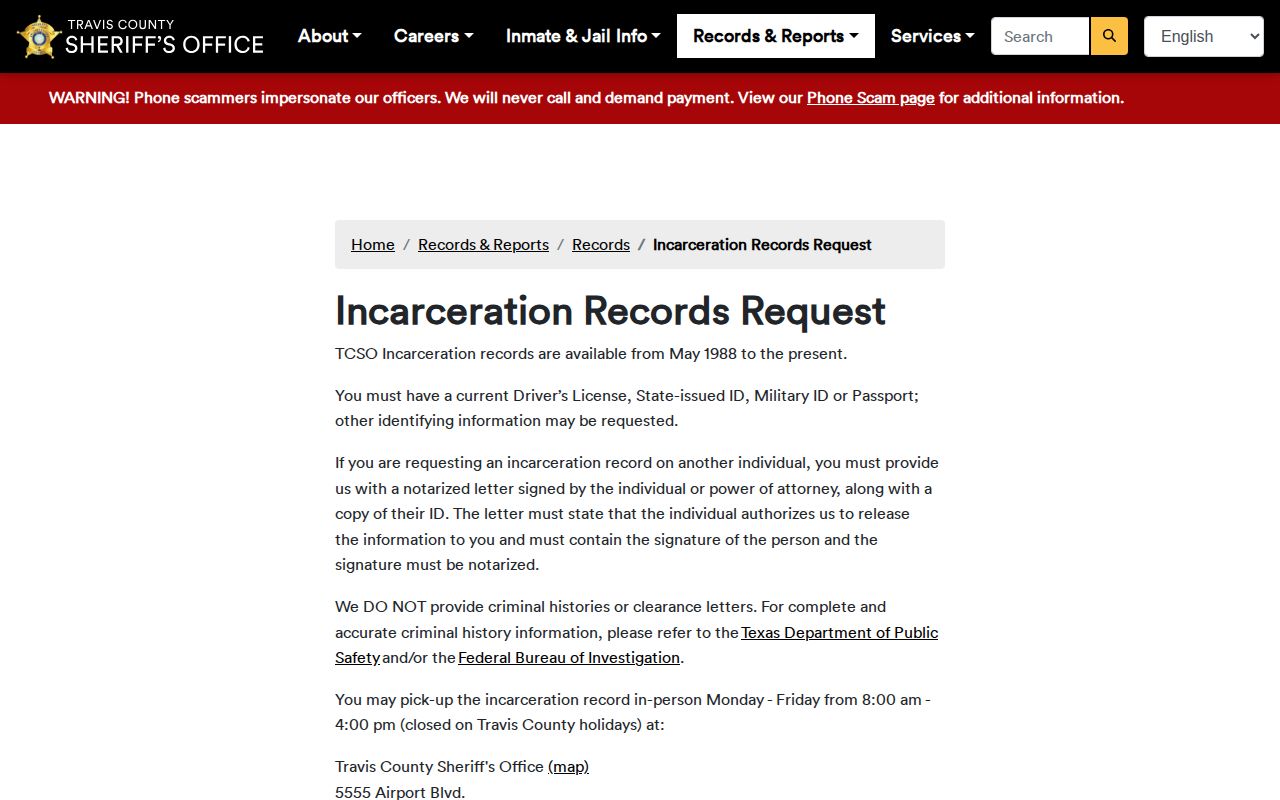
The captured instructions show why historical confirmation is a records product rather than a rolling three-day list.
Travis County Custody Outcomes
A TCSO current hit means the person remains in county custody at that update. No hit means only that current custody was not found. Texas VINE may show a county status-change event, but an urgent or disputed result should be confirmed with TCSO because automated data can lag.
| Evidence | Sound interpretation |
|---|---|
| Book-out with personal, cash, or surety bond | County confinement ended while the case may continue under conditions. |
| Book-out with time served or sentence satisfied | The recorded county stay ended on that basis. |
| Transfer to TDCJ, another county, USMS, or ICE | Travis County custody ended, but confinement continued. |
| Future TDCJ projected date | No actual state release has yet been proved. |
| Parole or mandatory supervision | Prison confinement ended, but state supervision continues. |
For a tighter same-day review, use Travis County 24-Hour Releases. The three-day method is designed for weekend and multi-day reconciliation.
No Travis County 72-Hour Feed
The absence of a sheriff feed is a distinctive local fact. Neither the downtown jail's historical pre-classification role nor the County Clerk's document-image lag creates a recent-release list. No official TCSO mobile app advertising a rolling release or mugshot feed was found.
Texas VINE or VINEMobile may help follow one person. It is an individual notification service, not a countywide roster of everyone who left in three days. If the person transfers to TDCJ, registration must move to TDCJ IVSS because county VINE does not automatically follow the person into the state system.
A state transfer requires a TDCJ search. A federal sentence belongs in the BOP locator, USMS pretrial or transport custody requires the Marshals Service and federal docket, and an immigration handoff belongs in ICE ODLS. A no-result in any one system does not establish community release.
Use confidence labels that match the proof. “Confirmed county release” calls for a TCSO book-out or direct custodian confirmation, ideally paired with the court basis. “Confirmed transfer” needs a movement record that identifies the receiving authority. If only an order exists, describe it as court-authorized release with the physical event unconfirmed. If all searches are negative, report only that the person was not currently found.
Note: A confirmed transfer should name the receiving agency; “not currently found” is the proper result when only negative searches exist.