
Travis County Projected Versus Actual Release
TDCJ uses Projected Release Date for a forward-looking calculation. It is based on factors that can include the offense date, offense type, sentence, good-conduct time, mandatory-supervision rules, and parole action. The field does not record a completed release. For some eligible older offenses, flat time plus good time may reach a mandatory-supervision date. For eligible offenses on or after September 1, 1996, reaching that calculation does not compel release because BPP approval is required.
A Scheduled Release Date is a later administrative plan. TDCJ may also publish a scheduled release location once processing advances. Classification and Records must audit the sentence and release certificate. TDCJ's Ombudsman has described about 14 to 21 business days for that audit in the cited release-processing scenario, while warning that a scheduled date can change without notice, even that day. An actual release is the physical event confirmed afterward.
Find a Travis County Release Date
First identify the custodian. The TCSO current inmate tool addresses people still in county custody, not past releases. A pretrial detainee has no sentence-based release date. Bond, dismissal, a personal-bond order, a detainer, or a later court ruling can change custody. For a county sentence, ask TCSO for the incarceration and movement record and review the judgment for sentence length and jail credit. A court order supplies legal authority, but another hold may still delay book-out.
Use the TDCJ Online Inmate Search only after the person entered the state system. Search by TDCJ or SID number when possible. If using a name, compare date of birth, conviction county, offense, and sentence. Open the correct detail and distinguish projected release, parole eligibility, parole review, and scheduled release. If a former record is absent, the TDCJ email, telephone, and Public Information Act channels remain available.
- Decide whether the matter is pretrial, a county sentence, or a TDCJ sentence.
- Match the person with a correctional number and supporting identity fields.
- Read the label beside the date instead of copying the date alone.
- Check the court judgment, holds, and parole result for factors that affect timing.
- Confirm the completed event with TCSO or TDCJ after the listed date.
The broader Travis County released-inmate lookup explains how a book-out or transfer record resolves a person who vanished from the live jail roster.
TDCJ Travis County Search Fields
TDCJ's public system lists location, offenses, and projected release information for the records it covers. It primarily serves current TDCJ-CID, prerelease, and parole-review needs. It is not guaranteed to return every old discharge. A county transfer into TDCJ means continued custody, even though the Travis County jail roster no longer shows the person.
The official TDCJ search form shows the identifiers available for a careful match.
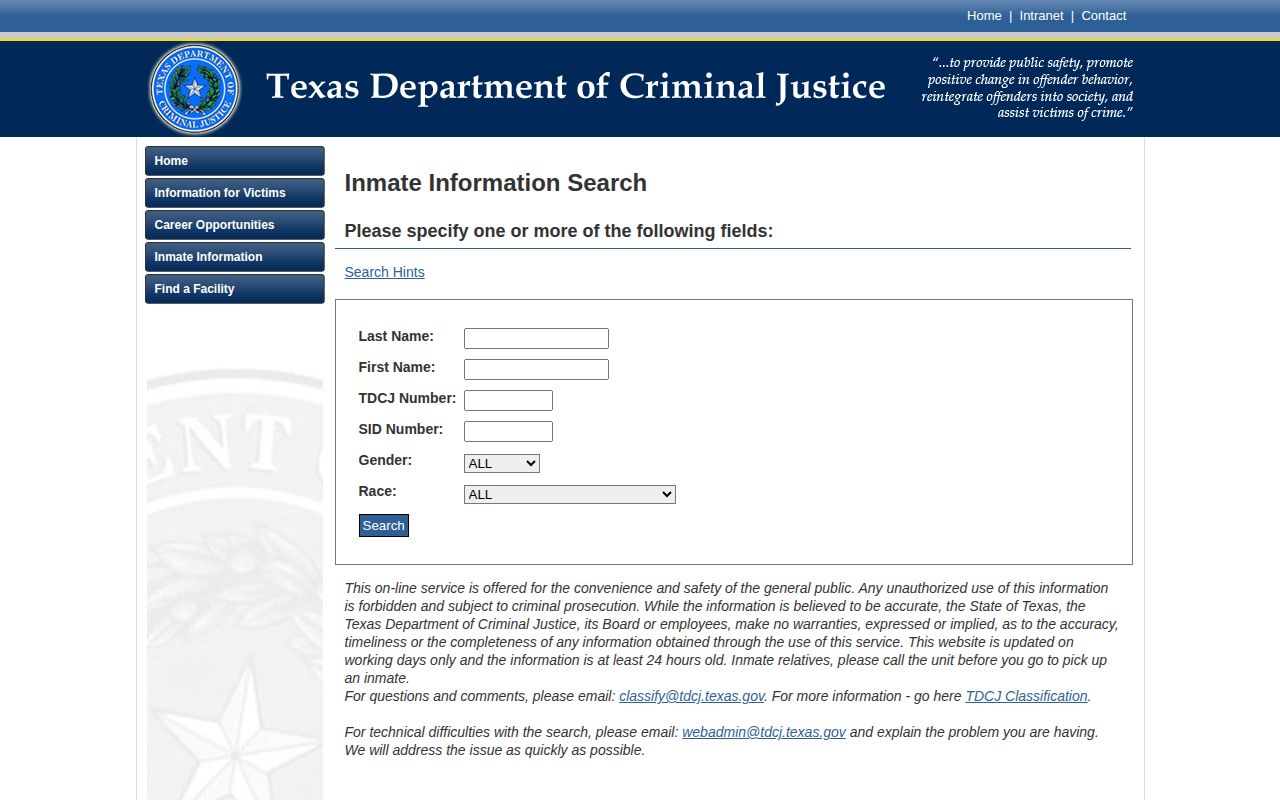
The fields reduce same-name errors before any projected date is interpreted.
| Field | Use |
|---|---|
| TDCJ number | Direct match to the state correctional record |
| SID number | Texas State Identification match |
| First and last name | Fallback search when numbers are unknown |
| Date of birth or age | Separates people with similar names |
| Conviction county | Tests whether the Travis County case is the relevant sentence |
| Offense and sentence | Provides context for the date and eligibility rules |
Texas Good Time Is Not 85 Percent
Texas has no general rule requiring every TDCJ prisoner to serve 85 percent of a sentence. That shortcut is unsupported and should not be used for a Travis County release-date estimate. Texas relies on offense-date and offense-category rules, good-conduct time for authorized calculations, discretionary parole, and mandatory-supervision exclusions. For offenses formerly called “3g” and now referenced through Code of Criminal Procedure Article 42A.054, and for certain deadly-weapon findings, Government Code §508.145(d) generally requires calendar time equal to one-half the sentence or 30 years, whichever is less, without good time, subject to statutory minimums and exceptions.
Government Code Chapter 498 calls good-conduct time a privilege, not a right. TDCJ sets classifications and rates. Participation credit under §498.003(d) cannot exceed 15 days for each 30 days actually served. Credits may affect eligibility or mandatory-supervision calculations where the law permits, but they do not shorten the sentence written in the judgment. Credits can also be forfeited.
For many general parole-eligible cases, §508.145 uses actual calendar time plus good-conduct time equal to one-fourth of the sentence or 15 years, whichever is less. Other categories differ. Section 508.149 excludes specified offenses and findings from mandatory supervision. The offense date and actual judgment control, so no reliable estimate comes from sentence length alone.
Travis County Jail Good Time
County jail credit is separate from TDCJ good time. Code of Criminal Procedure Article 42.032 §2 permits a sheriff to deduct no more than one day for each day actually served for good conduct. The law says the sheriff “may” award the deduction. It does not promise two-for-one credit for every Travis County sentence.
Three records answer three different questions. The judgment can state sentence length and credit. TCSO maintains the jail custody and movement event. TDCJ maintains a state projection if the person was sent to prison. Bond does not perform the same job as sentence credit. A release date should never be calculated by combining rules from these systems without confirmation from the court and custodian.
Why Travis County Release Dates Change
A projected or scheduled date can move for reasons that are not visible in a simple name result. TDCJ may award or forfeit good time. Sentence records may be aggregated or corrected. Another county, federal agency, or immigration authority may lodge a detainer, which is a request or legal basis to hold or transfer a person. BPP may deny discretionary mandatory supervision, approve it later, or require a program or release plan first.
Administrative steps also matter. A residence plan may need approval. Classification staff must audit the certificate. A new court order or case can change the custody path. These events do not all have the same legal effect, so the record should name the factor rather than merely presenting a revised date.
| Factor | Possible effect | Confirm with |
|---|---|---|
| Good-time award or loss | Changes an authorized eligibility calculation | TDCJ or TCSO, depending on custody |
| BPP decision | Moves review or permits release with conditions | BPP and Parole Division |
| Detainer or new case | Delays community release or causes transfer | Holding agency and court |
| Program or residence approval | Delays scheduling after a favorable vote | TDCJ release processing |
| Certificate audit | Corrects or finalizes the administrative date | TDCJ Classification and Records |
Travis County Date Request Options
TDCJ's free email service is useful when the online result is incomplete. Email pia@tdcj.texas.gov with the full name and seven-digit TDCJ number. If that number is unknown, provide the exact date of birth or an approximate age plus conviction county. The service can return the TDCJ number, location, conviction offense, incarceration information, and projected release date. It does not provide photographs or Social Security numbers.
The TDCJ projected-date and email guidance defines the field and the needed identity details.
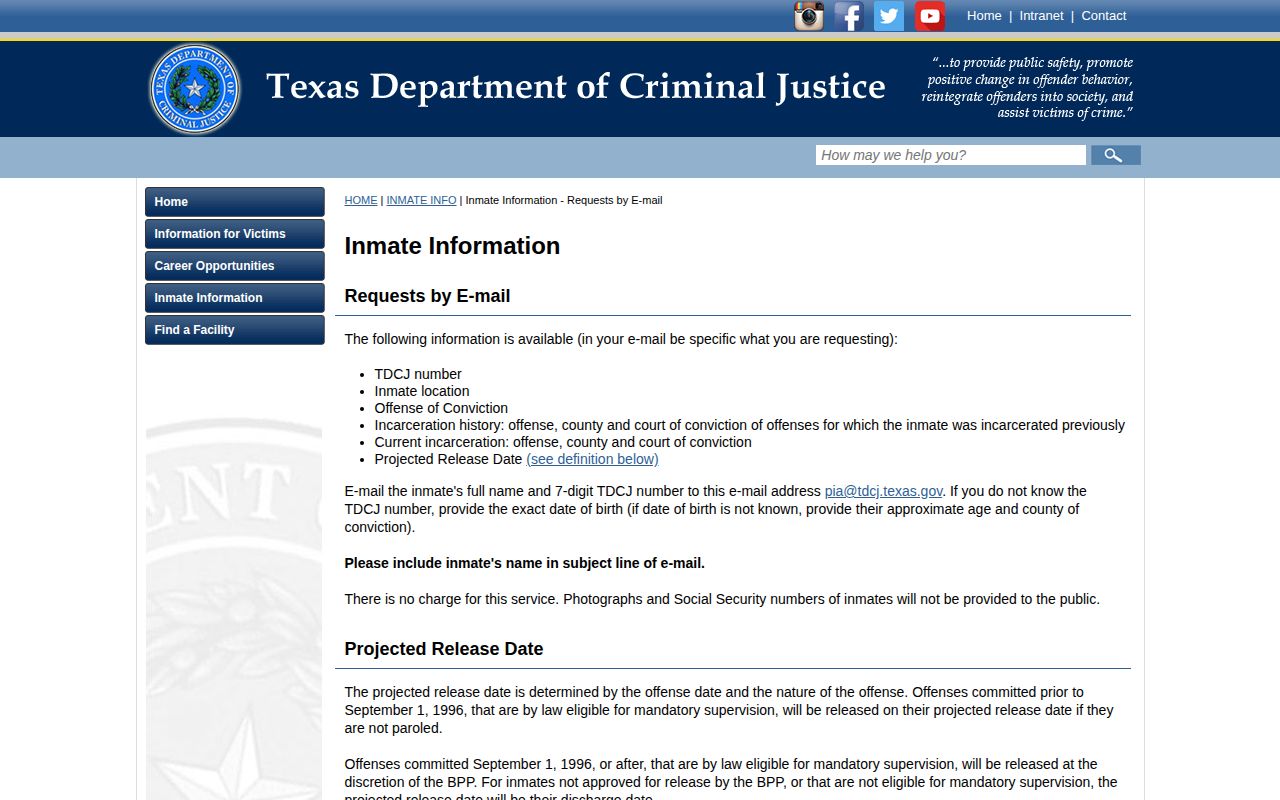
The official explanation reinforces that the projected date is a calculation, not a completed release.
Telephone channels depend on stage. General inmate locator service is available at 936-295-6371 or 800-535-0283. BPP pre-vote review status is 844-512-0461. Post-vote TDCJ Parole Division release status is 512-406-5202. These lines operate Monday through Friday from 8:00 a.m. to 5:00 p.m. Use the number or exact date of birth requested by the agency.
Confirm Travis County Actual Release
After the scheduled date, seek an affirmative custody event. For a county matter, the TCSO release or movement record can distinguish community release from transfer to TDCJ, another county, USMS, or ICE. For a state case, a TDCJ release certificate, status confirmation, or IVSS event can show the state action. Release on parole means the sentence continues under supervision; discharge means the sentence or supervision ended.
Notification helps with timing but does not replace the final record. Texas VINE applies to participating county custody, while TDCJ IVSS covers state custody and parole events. Automated data can lag. If timing is urgent, confirm directly with the responsible agency and review any new court order or detainer. A favorable board vote, scheduled date, and actual release should remain three separate entries.
Travis County Court Date Evidence
Court records can explain the legal basis for a custody change without proving the exact moment of release. Travis County uses the Odyssey portal, but the District Clerk maintains adult felony records while the County Clerk maintains misdemeanor cases. Look for a judgment, sentence, bond order, dismissal, jail-credit language, revocation, or later order. A register of actions may identify the filing even if the image is unavailable.
Timing in the court portal must not be confused with jail timing. County Clerk case data update about every 24 hours, and new document images can take about 72 hours. Those are publication intervals for court information, not projected release rules. A judge may authorize release while a separate hold keeps the person in custody. Pair the order with the TCSO movement record, or with TDCJ status when the judgment commits the person to state prison.
A certified copy may be appropriate when the date must be supported in a formal proceeding. District Clerk felony records are available through online, mail, and in-person channels, while County Clerk procedures apply to misdemeanors. Ask for the specific judgment or order rather than a new calculation. Clerks preserve the judicial record, but they do not operate the jail gate or certify TDCJ's later administrative release date.