
Travis County Parole Versus Probation
Parole and probation are not two names for the same status. Parole follows a Texas Department of Criminal Justice prison sentence. The Texas Board of Pardons and Paroles makes release decisions, while the TDCJ Parole Division manages supervision after release. Mandatory supervision is another form of supervised state release governed by the sentence, offense date, statutory eligibility, and board action. A person on either form remains under the state sentence outside prison until discharge or another lawful end.
Probation, which Texas records often call community supervision, is imposed by a court and managed locally by the Travis County Community Supervision and Corrections Department. It may be part of the judgment without any TDCJ prison release. Bond conditions are different again. Someone who leaves Central Booking on bond is not automatically on probation or parole. The court case, TDCJ record, and supervising agency must be read together.
| Feature | Parole or mandatory supervision | Probation |
|---|---|---|
| Source | TDCJ prison sentence and BPP action | County or district court order |
| Local manager | TDCJ Parole Region IV | Travis County CSCD |
| Best first record | TDCJ offender and parole status | Travis County criminal case |
| Ending record | Parole or sentence discharge | Court or CSCD discharge |
Verify Travis County Supervision Status
Start with the custody system that held the person. A former Travis County jail detainee may have left on bond, completed a county sentence, entered probation, or transferred to TDCJ. Only the relevant order or agency record resolves that path. For a person who entered state prison, use the TDCJ Online Inmate Search. A TDCJ number or State Identification number gives the strongest match. Otherwise compare the full name, date of birth, conviction county, offense, and sentence details.
A current TDCJ result may show prison location, projected date, or parole-review information. It is not a complete historical index of every discharged person. If a former record does not appear, ask TDCJ by email, telephone, or Public Information Act request for release, discharge, sentence, and supervision fields. For probation, review the Travis County Odyssey criminal case and ask CSCD to confirm releasable status information. A court order can prove that supervision was imposed, while CSCD is the operational source for whether it remains active.
- Identify whether the sentence belongs to TDCJ or a Travis County court.
- Match the person with a correctional number, date of birth, conviction county, and cause number when available.
- Read the status terms precisely: eligible, approved, scheduled, released, and discharged describe different stages.
- Contact the correct Austin parole office or Travis County CSCD for the supervising-office layer.
- Request the underlying release or discharge certificate when durable proof is needed.
Travis County Supervision Offices
Travis County is served by TDCJ Parole Region IV's Austin I and Austin II district parole offices. Both are at 1616 Headway Circle, Austin, Texas 78754. Austin I is on the second floor. Austin II and its Day Reporting Center are on the first floor. The published shared telephone number is 512-339-9142. The directory identifies the proper local office, but it is not a public list of all people under supervision.
Travis County CSCD handles local community supervision and publishes 512-854-4600 as its main contact. Callers should have enough information to distinguish the correct person and case, such as full name, date of birth, and cause number. Confidentiality rules can limit what staff disclose. A records request may be the better route for a recorded release date, discharge date, supervising officer, status, or warrant number when those fields are public.
Austin supervision contacts
TDCJ Austin I and Austin II
1616 Headway Circle
Austin, TX 78754
512-339-9142
Travis County CSCD
512-854-4600
Travis County Parole Decision Records
Texas does not hold a formal public hearing for each initial parole or mandatory-supervision decision. BPP panel members review files individually. A three-member panel decides through two concurring votes. TDCJ generally identifies a case months before eligibility for review, but that review schedule is not a release appointment and should not be treated as one.
Vote codes carry conditions. FI-1 and other FI or CU-FI codes may connect approval to an eligibility date, a program, or another prerequisite. NR means a later review, while SA means serve all. New information can lead to reconsideration or rescission. Thus an approval is not proof that a person physically left prison. Before a vote, the BPP status line is 844-512-0461. After a favorable vote, TDCJ Parole Division release processing at 512-406-5202 is the right source for scheduled or completed release questions. Both telephone paths operate weekdays from 8:00 a.m. to 5:00 p.m.
The official BPP parole review results explanation shows why decision terms need care.
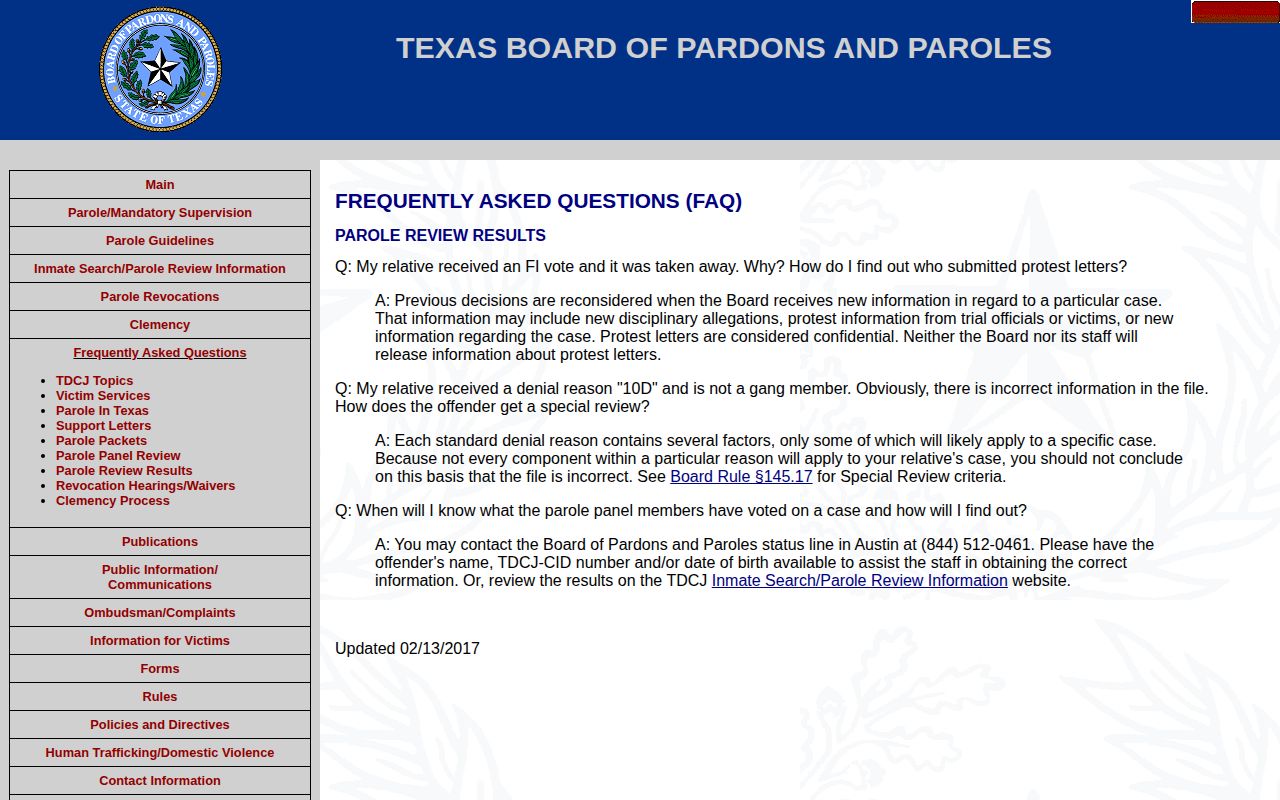
The screen supports interpretation of a board result, while the Parole Division remains the source for the later release event.
Travis County Warrants and Violations
A violation is an alleged breach of a supervision condition. It does not by itself state the final outcome. Depending on the proceeding, authorities may continue supervision, change conditions, order a placement, or revoke release. Revocation means supervised release is withdrawn and custody may resume. BPP revocation dockets relate to people already under supervision; they are not initial parole calendars.
TDCJ links a Sex Offender Absconder Information Search, but that search is narrow. It cannot serve as a general list of all parole absconders. An absconder is a supervised person alleged to have stopped reporting or otherwise avoided supervision. Verify a general parole warrant through the district parole office, TDCJ Parole Division Warrants at 512-406-5398, or a proper public-information request. No online result does not prove that a warrant is absent. A probation revocation warrant likewise can return a person to custody after an earlier jail release.
Travis County Release Notifications
County and state notification systems also differ. Texas VINE covers participating county jail custody. Travis County recommends it for basic jail custody information and a call before release. TDCJ IVSS covers state prison custody and parole or mandatory-supervision events. A person registered in county VINE must register again in IVSS after a transfer into TDCJ because the systems do not automatically merge registrations.
IVSS can provide notices by email, letter, text, and some telephone channels for events such as parole eligibility, board decisions, prison release, and discharge. Registration information is confidential. The TDCJ IVSS portal presents both offender search and registration paths.
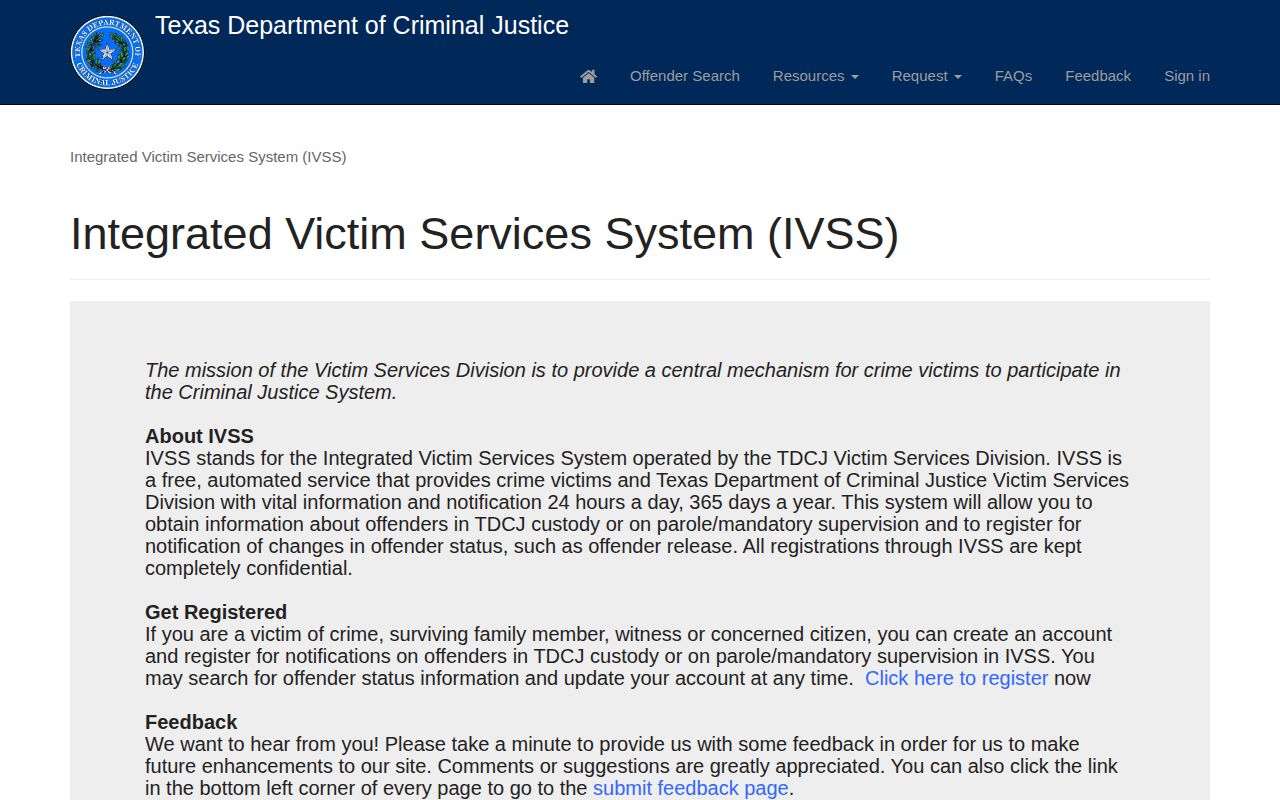
The portal is a state-system route; it does not replace Texas VINE for a person held only in the Travis County jail.
Travis County Reentry After Release
Verification is only one part of a stable return. Travis County's Start Your Next Chapter intake offers case management, peer support, and help recovering vital documents. Integral Care also operates a jail-based navigation path that can connect eligible Travis County Correctional Complex detainees with behavioral-health care before release. These programs are service routes. They do not prove a release date or supervision status.
That distinction matters for a person on parole or probation. A supervising office manages legal conditions, while a reentry provider may help with identification, care, or day-to-day needs. Contacting one does not substitute for contacting the other. When a person needs both, keep the records inquiry limited to the agency that created the status and use the service intake for practical support.
Property and IDs After Release
TCSO has detailed property procedures that can matter after a custody change. Valuables may be released to an authorized person who presents valid identification. Release clothing is held separately. Property left after a transfer to prison may be discarded after 30 days, so a transfer record should be resolved promptly rather than treated as community release.
Vital documents follow a different path. Travis County reentry intake may help recover a birth certificate or state identification. The need for replacement identification does not reveal parole or probation status, but it can affect access to services and compliance tasks. A person or authorized helper should confirm the jail movement, ask TCSO about property under its published procedure, and then contact the relevant supervision and reentry offices. The main Travis County released-inmate search explains how the county record confirms whether the event was a release or transfer.