
Texas TDCJ Release Paths
The Texas Department of Criminal Justice is the statewide prison and parole system. It is not the Travis County jail. A person booked by TCSO who later enters TDCJ has moved from county detention into state imprisonment. The county roster may stop displaying the person, but that change is a transfer rather than release to the community.
TDCJ separates physical release from complete discharge. Parole and mandatory supervision allow a person to live outside prison while remaining under state authority and conditions. A residential reentry placement can also be part of the supervision path. Discharge ordinarily means the sentence and supervision obligation ended. A movement from one TDCJ unit to another remains state custody.
| TDCJ event | Meaning | Best confirmation |
|---|---|---|
| Unit transfer | Continued state imprisonment | Current unit in TDCJ record |
| Projected release date | Forward-looking calculation | TDCJ offender detail |
| Scheduled release | Administrative plan that may change | Scheduled date and location fields |
| Parole or mandatory supervision | Outside prison under supervision | Release certificate and Parole Division |
| Discharge | Sentence or supervision obligation ended | TDCJ discharge record |
Confirm a Texas TDCJ Release
The TDCJ Online Inmate Search is the first state route. A TDCJ or State Identification number reduces same-name errors. Name searches require close comparison with date of birth, conviction county, offense, location, and other returned details. Travis County identifies the conviction or local case connection, not the prison location.
- Search by TDCJ or SID number when known; otherwise use the available name and demographic fields.
- Open the matching offender detail and compare identity, conviction county, offense, and current location.
- Read projected and scheduled fields literally. Neither proves that the physical event occurred.
- After the date, check release, parole, mandatory-supervision, or discharge status through TDCJ channels.
- If online history is missing, request the incarceration history and release or discharge records directly.
The statewide screen shown below is the matching official search source. It demonstrates the entry fields without displaying a person's private contact information.
Open the official TDCJ offender search and use a correctional number when available.
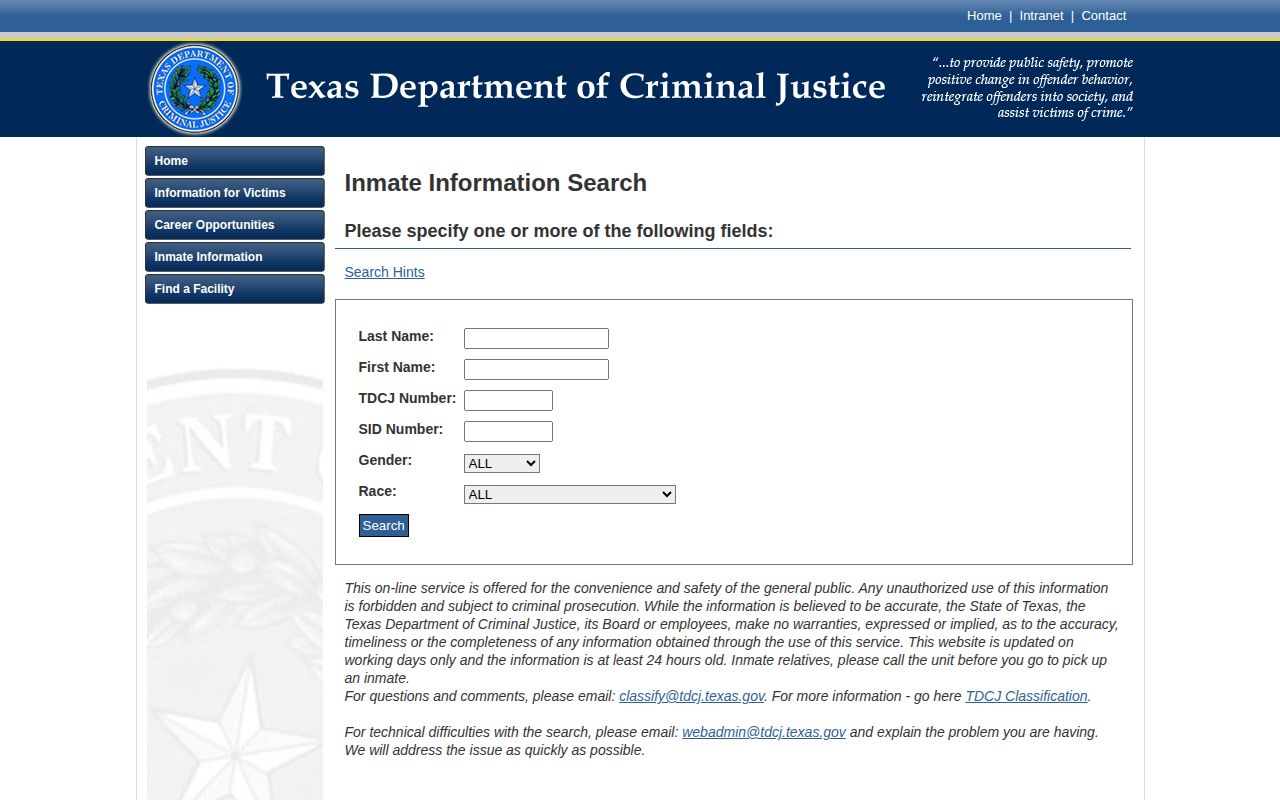
The form is statewide, so a person sentenced in Travis County may appear at any current TDCJ unit.
Texas TDCJ Release Contacts
TDCJ divides phone help by the stage of the state process. General inmate locator service is available at 936-295-6371 or 800-535-0283 from 8:00 a.m. to 5:00 p.m. Monday through Friday. Before a Board vote, parole-review status goes to 844-512-0461. After a favorable vote, scheduled and actual release questions go to the Parole Division at 512-406-5202.
TDCJ Public Information RequestP.O. Box 4017
Huntsville, TX 77342
PIA@tdcj.texas.gov
A formal request can seek the release certificate, discharge certificate, release date and type, sentence history, and recorded supervision fields. Identify the person by full name, TDCJ or SID number, date of birth, and a useful date range. Government Code Section 508.313 protects detailed parole-file material, so TDCJ applies the relevant exceptions and redactions.
Travis County TDCJ Connections
The TDCJ Travis Unit, unit code TI, is a male state correctional facility at 8101 FM 969 in Austin. It is operated by TDCJ, not TCSO. A person leaving that unit follows statewide prison release, parole, mandatory-supervision, and discharge procedures. A transfer to another TDCJ unit is not release.
A local court judgment can show that a person was committed to TDCJ, but it does not show the final state release event. County jail time applied to a sentence, a state projected date, and a Board vote answer separate questions. Match the Travis County judgment and TCSO transfer entry to the TDCJ number, then let the state record establish later unit placement, release, supervision, or discharge.
Austin Transitional Center at 3154 Highway 71 East in Del Valle is listed by TDCJ as a Parole Division Residential Reentry Center operated by CoreCivic. Presence there represents a supervised residential or reentry layer. It should not be described as unrestricted discharge. Verify the supervising office and current status through TDCJ.
The Austin I and Austin II parole offices are at 1616 Headway Circle, Austin, Texas 78754, with published phone number 512-339-9142. Those offices can help with supervision routing, but a parole-office record does not provide the county jail's earlier book-out time.
Texas TDCJ Date Language
TDCJ calls its forward-looking field the Projected Release Date. The calculation depends on the offense date, offense category, good-conduct time rules, and mandatory-supervision law. For some eligible cases, reaching the calculation still requires Board approval. A denial can cause the projected date to move to maximum expiration, while later approval may move it earlier.
A Scheduled Release Date and Scheduled Release Location can appear after approval and administrative work. TDCJ warns that the date may change without notice, even on the scheduled day. Classification and Records must audit the release certificate and calculation. The physical event needs confirmation after the scheduled date.
- Projected
- A calculation, not an event.
- Eligible
- The person may be considered under governing law.
- Approved
- A Board decision that may still have prerequisites.
- Scheduled
- An administrative plan subject to change.
- Discharged
- The state sentence or supervision term ended.
Texas TDCJ Search Fallbacks
The public online system is chiefly a current TDCJ-CID, prerelease, and parole-review tool. It is not guaranteed to return every discharged person in a permanent historical index. Failure to locate an older record does not prove the person never served a Texas sentence.
TDCJ's inmate-information email route can supply a number, location, conviction offense, prior or current incarceration information, and projected date without charge. Send the full name and seven-digit TDCJ number. If the number is unknown, include exact date of birth or approximate age and conviction county. That email route does not provide photographs or Social Security numbers.
For a complete historical record, use the formal Public Information Act route. Ask for existing records rather than a new explanation. The Travis County release search explains how the earlier county movement and court judgment connect to the later state record.
Texas TDCJ Release Evidence
A reliable state release account preserves the full name, TDCJ or SID number, unit, source, check time, event time, and exact event wording. The observation time and event time are not interchangeable. A search reviewed Tuesday may report a Monday release. When dates conflict, compare the scope and update time of each official source before choosing.
A favorable Board vote is not physical release. The vote can carry program, residence, or other prerequisites, and it may be reconsidered when new information arises. A release certificate or affirmative TDCJ event is stronger. For post-vote questions, the Parole Division line serves a different role from the pre-vote Board status line.
Another hold can change the outcome. A person may complete a TDCJ term and enter another lawful custody system. Conversely, an old TDCJ release can precede a new Travis County booking. State and county records can both be accurate when they describe different dates. Never treat one database as a universal custody record.
Texas TDCJ Records Compared
Use the document that answers the question. The offender detail supplies current state information and projected or scheduled fields when available. The release certificate documents release terms. A discharge certificate supports completion of the sentence or supervision term. Sentence history and incarceration history connect separate admissions, convictions, and custody periods.
Texas public-record rules allow TDCJ to redact or withhold protected material. Detailed parole files have special confidentiality rules, while general recorded release and supervision facts may remain available within statutory limits. A narrow request naming the exact record and date range is easier to process than a request asking the agency to explain everything that happened.
Texas TDCJ Notification Systems
TDCJ IVSS is the state custody and parole notification system. A registration created in county VINE does not automatically follow a person after transfer to TDCJ. Create an IVSS account, find the state offender record, and select the notices supported for that custody or supervision stage.
IVSS can provide prison release, discharge, parole eligibility, Board decision, and certain movement notices. Registration information is confidential. Conversely, IVSS does not replace Texas VINE for a person held only in the Travis County jail. Match the notification system to the current custodian.
Note: A county transfer to TDCJ ends the Travis booking, but it begins or continues state custody rather than community release.