
Travis County Jail Release Paths
Travis County Jail contains the Central Booking Facility, the intake hub for arrests made by more than 30 area law-enforcement agencies. Booking, identification, magistration, and short-term holding take place downtown. A person can leave county custody after a cash, surety, or personal bond, a dismissal, time served, sentence completion, or another court release order. Yet the same booking can end with a move to the Travis County Correctional Complex, TDCJ, another county, a hospital, USMS, or ICE. Only the first group necessarily describes return to the community.
Movement from downtown to Del Valle is especially easy to misread. Both sites form one TCSO adult correctional system. A facility field that changes from Travis County Jail to the correctional complex records an internal placement, not a book-out. Likewise, a county book-out that names a receiving agency documents a transfer. It should not be shortened to “freed.”
| Recorded outcome | What it means | Next check |
|---|---|---|
| Bond, dismissal, time served | Possible community release | Confirm book-out and other holds |
| Move to TCCC | Still in TCSO custody | Use the live TCSO lookup |
| Transfer to TDCJ | Continued state imprisonment | Use TDCJ offender information |
| USMS or ICE handoff | Federal or immigration custody may continue | Follow that agency's system |
Confirm Travis County Jail Release
The strongest proof pairs the jail event with the legal basis in court. The TCSO inmate information route is a current-custody tool. A positive match means the person was still held at the stated update. No match is only a lead because the person might have been released, transferred, or moved into a custody system outside the county.
- Search the full name in the current TCSO tool and record when the check was made.
- Use the District Clerk for felony cases or County Clerk for misdemeanors. Look for bond, dismissal, sentence, commitment, or release orders.
- Request the TCSO booking sheet and final book-out, release, movement, or transfer entry. Ask for the date, time, disposition, releasing authority, and receiving agency.
- If the record shows TDCJ, USMS, or ICE, continue in the matching state or federal channel.
The broader Travis County released-inmate search explains how to reconcile county, court, state, and federal results when the path is unclear.
Travis County Jail Release Records
TCSO offers a defined incarceration-record product for records from May 1988 to the present. The published fee is $15. Pickup is at 5555 Airport Boulevard on weekdays from 8:00 a.m. to 4:00 p.m., excluding county holidays. Current government photo identification is required. A request about another person must satisfy the authorization rules on the official form, including the stated notarized authorization or power-of-attorney and identification-copy requirements.
For a tailored response, use the TCSO open-records route. Ask for existing documents and fields rather than an explanation. Useful terms include booking sheet, book-in and book-out timestamps, final release or transfer disposition, releasing authority, receiving agency, movement history, and releasable bond or hold entries. Include the full name, aliases, date of birth if lawfully known, booking number, and date range. Texas law calls for prompt handling, but ten business days can be a response or ruling deadline rather than a promise of final delivery.
- Book-out
- The jail's recorded end of a booking episode.
- Disposition
- The recorded outcome for a charge or custody event.
- Detainer
- A request or authority that can keep custody in place after another matter resolves.
- Transfer
- A move to another custodian, not necessarily release to the public.
Central Booking Release Paperwork
The official arrest and booking page identifies Central Booking and explains that release paperwork includes court-date information, although counsel can also obtain it. The image below captures that official page and helps distinguish booking and release processing from later court records.
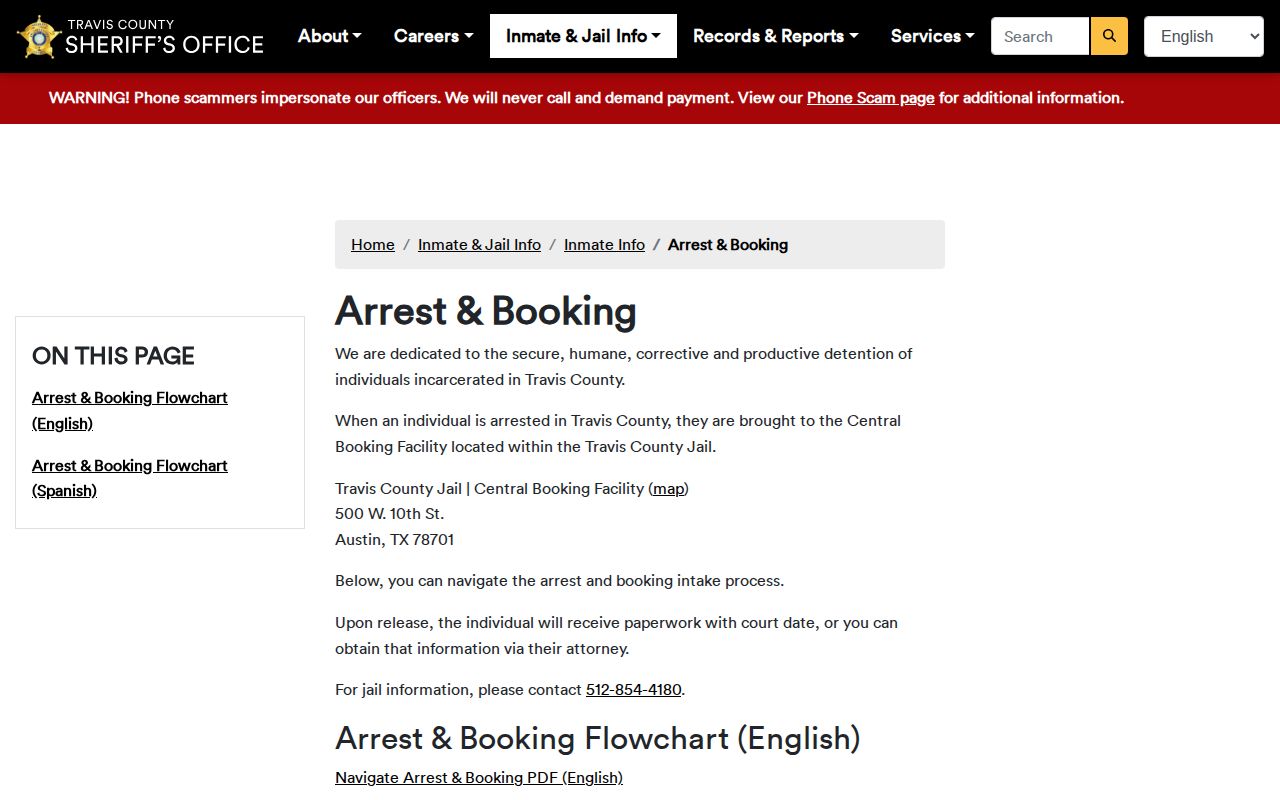
The screenshot supports the downtown facility's role in release processing. It does not supply a person's actual book-out time, which must come from the individual record.
The jail event and court case answer different questions. A signed bond or dismissal order shows why custody should change, while a final jail movement shows whether the person left and whether another authority took custody. One charge can resolve while another charge or hold keeps the booking active. That is why a charge-level disposition alone is not proof of physical release.
Travis County Jail Property Release
TCSO separates valuables from release clothing. Its property instructions allow a person in custody to authorize the entire valuables bag or specified money to a designee who presents valid identification and the required form. Central Booking valuables may be released Sunday through Friday around the clock to help facilitate release, while other published windows differ by site and property type. Confirm the current window before making a trip.
A transfer to prison changes the practical task. TCSO advises designating a recipient for property and warns that unclaimed items can be discarded after 30 days. Property pickup does not prove release, and possession of clothing or valuables does not identify the legal disposition. It is a separate post-custody step that can continue after the person moves to TCCC or another authority.
Note: Facility plans and older master-plan descriptions do not establish that the currently published downtown booking facility has closed.
About Travis County Jail Records
Central Booking is at 500 West 10th Street in Austin. TCSO publishes 512-854-4180 for jail information. The neighboring court and pretrial buildings have their own counters and mailing addresses, so a court address should not be mistaken for the place where TCSO creates a book-out record. Felony case material belongs with the District Clerk, misdemeanor material with the County Clerk, and the custody event with TCSO.
Travis County Jail / Central Booking
500 W. 10th St.
Austin, TX 78701
Jail information: 512-854-4180
TCSO has not documented a rolling public 24-hour or 72-hour release feed or a fixed post-release web-retention period. For a near-term event, Texas VINE can provide a participating-agency custody-change notice, but an urgent or disputed result should still be checked with TCSO. For durable proof, the incarceration or open-records response is the better source.
Central Booking Court Connections
The jail booking identifies physical custody, while the court file explains legal authority. Felony causes are maintained by the District Clerk, misdemeanors by the County Clerk, and city ordinance or Class C matters may belong in municipal court. Search by cause number when possible. A bond on one case does not defeat a hold on another, and a commitment order can explain why someone left the local roster while remaining incarcerated.
Travis County Pretrial Investigations interviews people in custody and makes personal-bond recommendations, but a judge decides release and conditions. An interview is not a release order or proof that processing finished. Match any order to the final TCSO book-out.
Travis County Release Evidence
Keep the event date distinct from the date a source was checked. Record the name, booking number, last known facility, source, event wording, receiving agency, and both times. “Confirmed county release” needs an affirmative TCSO event. “Confirmed transfer” needs a movement that establishes the next custodian. A court order without a matching jail event supports only court-authorized release with the physical event unconfirmed.
When only a negative current-roster result exists, the sound finding is “not currently found.” That wording protects the distinction between release, transfer, and a database gap.
When Travis Jail Records Conflict
A county roster, court portal, VINE event, TDCJ result, and federal locator can each be accurate about a different date or custodian. Compare stable identifiers and timestamps before choosing an outcome. A newer affirmative custody event usually carries more weight than an older no-result. Call the responsible records or jail unit when an urgent question remains unresolved.
Do not publish an estimated release hour, personal destination, supervision condition, or medical detail that the official record does not support. The goal is a narrow, purpose-neutral finding: whether county custody ended, when the recorded event occurred, and whether the person entered another known custody system.
The public current search has no published promise that a released name stays visible. Underlying agency records can remain available even after web display ends. That difference is why a written TCSO request is more durable than a screenshot of a missing roster result.
TCSO reports that Central Booking processed about 30,000 people in 2023 from more than 30 law-enforcement agencies. The system's average daily population was reported as 2,275, with combined capacity of 2,812. These are booking and population measures, not release counts. They show why the downtown facility handles records from many arresting agencies and why a current-only roster is a poor historical archive.
For Texas VINE, confirm that the result names Travis County and compare the identity fields before relying on a status change. A release notice can support a recent event, but the final TCSO record remains the durable proof when timing or destination is disputed.