
Understanding Travis County Releases
Travis County released inmates do not all follow one path. Central Booking is the intake hub, and the Travis County Correctional Complex holds most longer-stay county detainees. A move between those two TCSO sites is an internal transfer. It is not a release. The same care is needed when a county booking ends because TDCJ, another county, the U.S. Marshals Service, or ICE receives the person. In those cases, Travis County physical custody ended while confinement continued elsewhere.
A community release can follow a cash, surety, or personal bond, time served, sentence completion, dismissal, acquittal, or another court order. Parole and mandatory supervision describe release from a Texas prison under state control. Probation, called community supervision in Texas law, is imposed by a court and handled locally. A discharge usually means the sentence or supervision obligation has ended. Death may terminate custody, but it must never be reported as a release.
- Book-out
- The jail's recorded end to a booking, whether by release or transfer.
- Parole
- Conditional release from state prison under TDCJ supervision.
- Probation
- Court-ordered community supervision, usually instead of or after jail.
- Discharge
- Completion of the sentence or supervision obligation.
Travis County Release Types
The label on the final custody event controls where to look next. A court order may explain why release was authorized, but it does not prove the person passed through the jail's release process. Another charge or hold can remain. The TCSO book-out or movement entry provides the physical custody event, while the clerk's file supplies the legal basis.
| Event | Meaning | Next record |
|---|---|---|
| Bond | Confinement ends while the case continues under conditions. | TCSO book-out and bond order |
| Time served | The court credits enough custody to satisfy the jail term. | Judgment, jail credit, and book-out |
| Dismissal or acquittal | One case ends, though another hold may remain. | Court disposition plus TCSO event |
| TDCJ transfer | County custody ends and state imprisonment begins. | TCSO movement and TDCJ offender record |
| Parole or mandatory supervision | Prison confinement ends under state supervision. | TDCJ release certificate and Parole Division record |
| Discharge | The state sentence or supervision term ends. | TDCJ discharge record |
Travis County Release Record Fields
A Travis County release record is often a chain of records rather than one sheet. The booking record identifies the custody episode. Movement history shows where the person was held. Bond and hold fields explain barriers to release. A final book-out entry supplies the date, time, disposition, and any receiving agency. The court register then shows the order, judgment, or disposition that authorized the change.
| Field | What it shows |
|---|---|
| Booking number | Connects documents to one custody episode. |
| Book-in date and time | When TCSO recorded the intake. |
| Arresting agency | Which local or outside agency initiated the booking. |
| Charges and cause numbers | Links the jail record to the correct court files. |
| Bond and holds | Conditions or other authority that may block release. |
| Book-out date and time | When the booking ended. |
| Release or transfer disposition | Whether the person left for the community or another custodian. |
| Receiving agency | Where custody continued after a transfer. |
Can roster absence confirm release? No. The official TCSO search is framed as a current-custody tool. A missing name supports further checking, but only an affirmative event or direct agency confirmation identifies what happened.
Request Travis County Release Records
TCSO offers a defined incarceration-record product covering May 1988 to the present for $15. Pickup is at 5555 Airport Boulevard in Austin on weekdays from 8:00 a.m. to 4:00 p.m., excluding county holidays. Current government photo identification is required. A request about another person is subject to the authorization and identification rules on the official incarceration records page.
- Collect the full name, aliases, booking number, and a narrow arrest or custody date range.
- Ask for the booking sheet, book-in and book-out timestamps, final release or transfer disposition, releasing authority, receiving agency, and releasable movement, bond, and hold entries.
- Use the TCSO public-information route for a tailored record or booking photograph. Request existing records, not a custom explanation.
- Choose electronic delivery when practical and ask for an estimate before work if cost is a concern.
- Match the jail event to the correct felony or misdemeanor court file.
5555 Airport Blvd.
Austin, TX 78751
Information: 512-854-9718
Fax: 512-854-7270
The Texas Public Information Act allows an agency to withhold or redact material covered by an exception. It does not require the sheriff to answer a narrative question or create a new report. Under Government Code section 552.221(d), an office that cannot produce public information within ten business days must give a reasonable date when it will be available. That is a notice rule, not a promise that every request closes in ten days.
Travis Release Records and Expunction
Texas Government Code Chapter 552 governs public-information requests, charges, and exceptions. Online visibility is different from agency retention. TCSO does not promise that former inmates remain on its live search for a set time, even though underlying records may be kept under state and local retention schedules.
Expunction and nondisclosure are also different. The Travis County District Clerk handles all expunction petitions and felony nondisclosures, while the County Clerk handles misdemeanor nondisclosures. An expunction under Code of Criminal Procedure Chapter 55A can require covered arrest records to be destroyed or returned. A nondisclosure limits release of specified records but does not erase every historic event. Juvenile, sealed, expunged, or confidential material should not be reconstructed from old copies.
Travis County Personal Bond Release
Travis County Pretrial Investigations interviews people in custody and makes personal-bond recommendations, but a judge decides whether release is allowed and what conditions apply. The unit works every day, which matters for cases moving outside ordinary courthouse hours. Still, a recommendation is not a release event. Confirm the signed order, any remaining holds, and the TCSO book-out.
Published personal-bond processing fees are $20 for a bond under $1,334 and $40 for a bond at or above that amount. An ignition-interlock condition can add a processing fee equal to three percent of the bond, capped at $300, plus a monthly monitoring fee. Because fees can change, check the current Pretrial Services fee page before making payment.
Why Travis Release Records Split
The Travis County system has high turnover and many arresting agencies. TCSO reports that Central Booking processed about 30,000 people from more than 30 law-enforcement agencies in 2023. The Corrections Bureau also reported an average daily population of 2,275 and combined capacity of 2,812. These figures describe bookings and custody, not the number of releases.
The scale helps explain why a current roster cannot serve as a durable archive. One person may enter through downtown Central Booking, move to Del Valle, and later leave under a court order or transfer. Each step can sit in a different record system.
Property After Travis County Release
TCSO separates sealed valuables from release clothing. A detainee may authorize the full valuables bag or specified money for pickup by a designee who presents valid identification and the official form. For a prison transfer, the person should name a recipient. The sheriff warns that unclaimed property can be discarded after 30 days. Property activity may explain why a family still deals with TCSO after custody has moved, but it does not confirm the date or type of release.
Travis County's Start Your Next Chapter intake offers case management, peer support, and help recovering vital documents such as a birth certificate or state identification. Those services support a transition. They are not custody databases, so release must still be verified through the sheriff, court, or TDCJ record.
Search Travis County Released Inmates
The strongest search begins with the last known custodian and date. Each database answers only for its own system. Keep the event date separate from the date the source was checked. A Tuesday screenshot may show a Sunday book-out, and both dates matter.
- Search the TCSO current-custody tool. A match means the person was then in county custody. A miss is only a lead.
- Search the District Clerk for felony cases and the County Clerk for misdemeanors. Look for bond, release, dismissal, judgment, commitment, probation, warrant, or later orders.
- Request the final TCSO book-out, release, or transfer event and ask that the receiving agency be identified.
- Search TDCJ when a state-prison transfer or state supervision is plausible.
- Use Texas VINE for participating county custody and TDCJ IVSS for state custody or parole notices.
- Use BOP, USMS, or ICE records only when federal or immigration custody fits the facts.
- Reconcile any conflict by identifiers, update times, and agency scope.
A person who leaves the live TCSO roster may have been released, moved within the system, or transferred. Confirm an affirmative custody event.
TDCJ Released Offender Search
The Texas Department of Criminal Justice search applies after TDCJ receives or supervises a person. It is not the Travis County jail roster. Search the TDCJ Online Inmate Search by TDCJ or SID number when possible, since stable numbers reduce same-name errors. Otherwise use the name and compare the date of birth, county of conviction, offense, and status on the detail page.
| Search field | Best use |
|---|---|
| TDCJ number | Most direct match to the state record. |
| SID number | Texas identification across criminal-justice records. |
| First and last name | Fallback when no number is known. |
| Date of birth | Separates people with similar names through email or phone inquiry. |
| County of conviction | Helps TDCJ locate a record when an identifier is missing. |
The official search screen shows how the state accepts those identifiers. View the TDCJ search source before comparing a result.
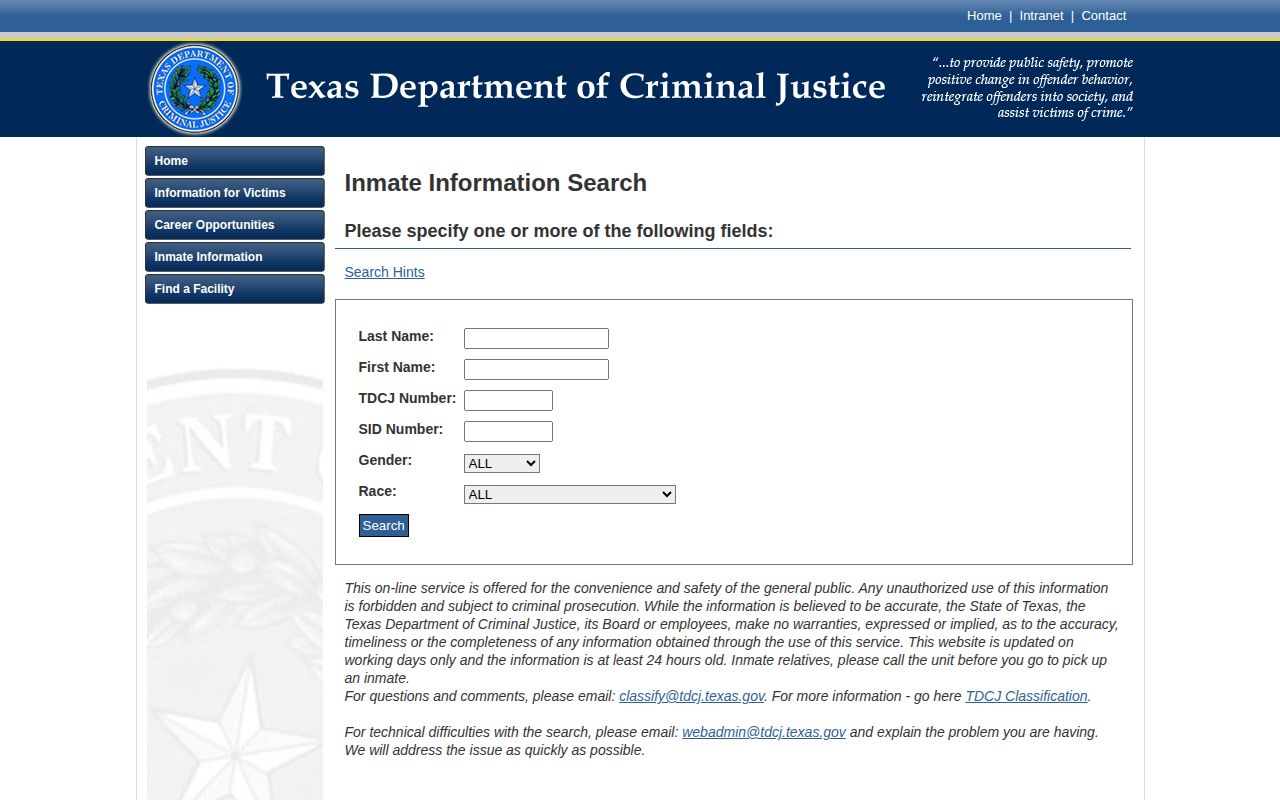
The screen supports state-record matching, but a projected date is not proof of release. A scheduled date can also change. Confirm an actual release, parole, mandatory-supervision, or discharge event through TDCJ records.
Travis Release Orders in Odyssey
Travis County uses one Odyssey portal but divides record responsibility by clerk. The District Clerk holds felony and district cases, felony nondisclosures, and all expunctions. Its public criminal coverage begins in 2008. The County Clerk holds misdemeanor cases and states that its case data update about every 24 hours, while new document images can take about 72 hours.
Those update periods are court-system timing, not sheriff release windows. Search the District Clerk case route or the County Clerk misdemeanor route, then pair the order with TCSO's physical custody event. A bond order or dismissal may coexist with another active case or hold.
Travis County Recent Release Search
TCSO does not publish an official rolling 24-hour or 72-hour release list. Its online tool searches current custody, with booking, facility, charge, bond, court, and disposition details. No documented overall release field, refresh cadence, or post-release retention period was found. The Travis County 24-Hour Releases route therefore begins with the current search, VINE, court records, and the incarceration-record request rather than a fabricated feed.
A charge disposition is not always the end of the booking. One count may resolve while another count or an outside hold keeps custody active. For a recent event, save the time of each check and ask TCSO for the final book-out or transfer disposition.
Verify Travis Post-Release Supervision
Parole follows a TDCJ prison sentence and is administered by the TDCJ Parole Division after a Texas Board of Pardons and Paroles decision. Travis County probation is imposed by a court and handled by the Travis County Community Supervision and Corrections Department. Release on bond does not automatically place a person in either group.
For state parole, compare TDCJ and BPP status, then use the Parole Division post-vote line when needed. For probation, use the court judgment and CSCD confirmation. The Post-Release Supervision page explains the Austin parole offices, local probation route, discharge, and warrant limits.
Travis Release Alerts and Transfers
Texas VINE covers participating county custody and can support a custody-change event or alert for one person. TDCJ IVSS is the separate state-prison and parole notification system. A county registration does not automatically follow a person into TDCJ custody, so registration must be made in the correct system.
Federal cases need federal sources. The BOP locator can show a release date for many federal inmates released after 1982. USMS handles many federal pretrial detainees, and ICE ODLS covers many immigration detainees. A TCSO transfer to USMS or ICE is not community release. A BOP release also does not rule out later county or state custody.
Getting Home After TCCC Release
CapMetro Route 271 Del Valle Feeder serves the Travis County Correctional Complex and connects toward the Grove and ACC Riverside corridor. It is a real transportation option, but schedules and connections change. The published route does not identify the physical release door, a family waiting area, or a guaranteed release hour. Check the current Route 271 schedule before travel and confirm pickup details with the facility.
Child-Support Capias Release Payments
Travis County has a narrow payment process for a child-support capias. During weekday business hours, the Domestic Relations Office handles the published payment route. Nights, weekends, and holidays are directed to the Sheriff's Bonding Office. The official instructions also distinguish the Attorney General case route and list accepted payment forms.
This procedure applies only to that type of capias. It should not be generalized to criminal bonds or other release orders. Confirm the case type and current instructions on the Travis County release-from-jail page before paying.
Travis Released Versus In Custody
The right system depends on who had custody. A negative result in one database cannot answer for another agency.
| System | What a positive result means | Released-person route |
|---|---|---|
| TCSO live search | Current county custody at the stated update | Request the book-out and court basis |
| Travis court records | An order, judgment, or case event exists | Pair it with the TCSO physical event |
| TDCJ search | State custody, review, supervision, or published status | Confirm actual release or discharge through TDCJ |
| Texas VINE | Participating county custody event or alert | Verify urgent changes with TCSO |
| BOP locator | Federal custody or a federal release record | Read the date and status within federal scope |
| ICE ODLS | Locatable immigration custody record | A missing result does not prove release |
Travis County Release Facilities
Adult county arrests enter through the downtown jail and Central Booking, while most longer stays occur at TCCC. Municipal arrestees who need confinement generally enter the county system. Juvenile detention remains confidential and outside the adult lookup. TDCJ, BOP, USMS, and ICE each require their own search path.
- Travis County Jail / Central Booking Facility: county intake and short-term custody.
- Travis County Correctional Complex: the main longer-stay county complex.
- Austin Police Department holding: municipal intake that normally routes confined adults to TCSO.
- Other Travis County municipal holding: temporary police custody with agency and court follow-up.
- Gardner Betts Juvenile Justice Center: confidential juvenile custody.
- Texas Department of Criminal Justice: statewide prison and parole records.
- Federal Bureau of Prisons, U.S. Marshals Service, and ICE custody: federal-system routes.