
Travis County VINE Coverage
Texas VINE on VINELink is the participating county-custody path for a person held by Travis County. It can return a custody record, location or agency, a status-change event, update context, and notification choices. Travis County also recommends VINE for basic jail information and a call before a release. It is a person-specific tool, not a list of everyone released today.
Texas divides county and state notifications. A transfer from TCSO into the Texas Department of Criminal Justice is continued custody, not community release. Once TDCJ receives or supervises the person, use the Integrated Victim Services System, known as IVSS. County VINE registration does not automatically continue into IVSS, so a new state registration is needed.
Neither system covers every kind of custody. The BOP locator serves federal sentences, USMS channels and the federal docket help with federal pretrial or transport custody, and ICE ODLS covers many immigration detainees. A missing VINE result does not establish that the person is free.
Check a Travis County Inmate
Begin with enough identity detail to distinguish the intended person from a same-name record. The agency and status timestamp are as important as the name. For broader reconciliation with jail and court records, use the Travis County released-inmate search.
- Open VINELink and select Texas. Choose the offender or custody search offered by the current interface.
- Search by the available name or ID fields. Use a stable ID when known because it reduces same-name mistakes.
- Open the possible match and confirm that the listed custodian or agency is Travis County.
- Compare all available identity fields before treating the result as the right person. Do not register against a name alone.
- Read the custody status, event wording, and last-update context together. Save the date and time checked.
A released or noncustodial event supports a recent departure from the listed agency. It does not rule out another hold or transfer. If the record names or suggests a new custodian, follow that agency's official system.
Open the official Texas VINE search to review the current name and ID fields.
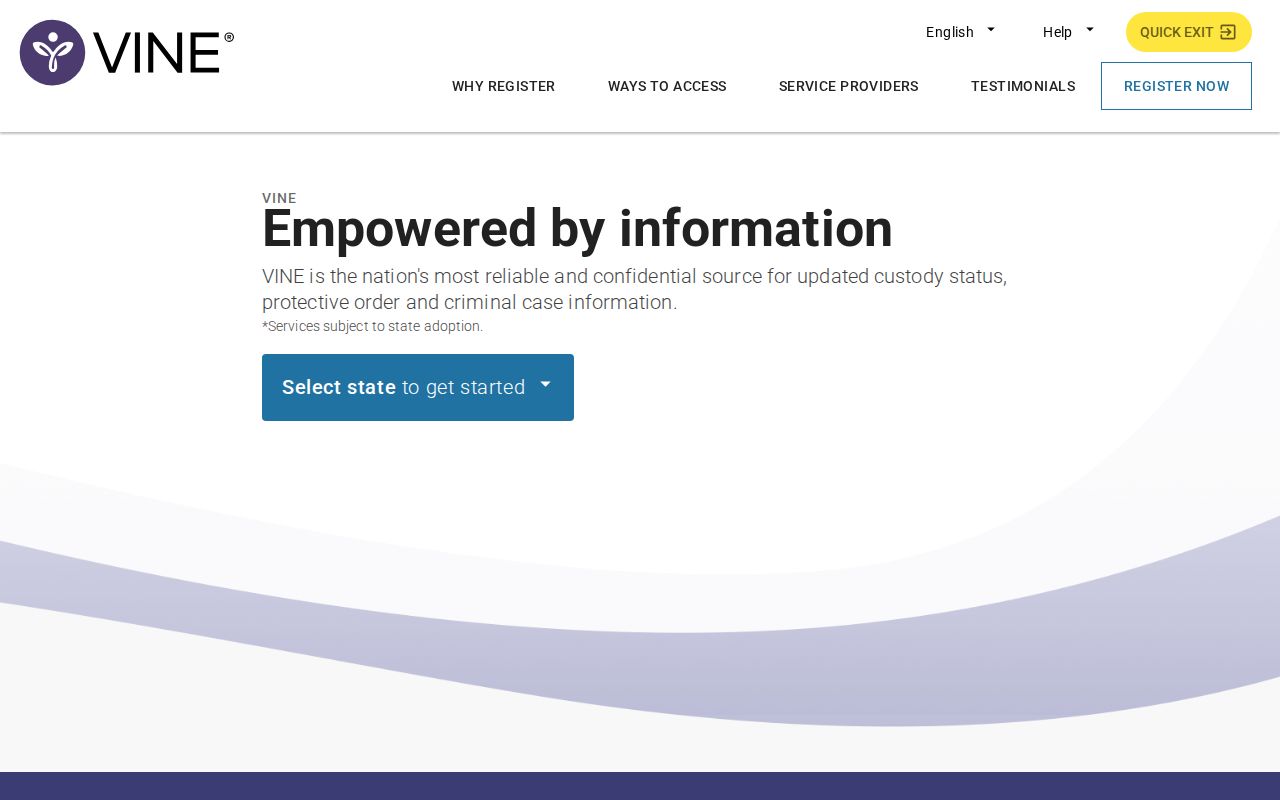
The captured Texas screen shows the search entry point used to locate one matching custody record before registration.
Travis County VINE Record Fields
The exact display can change by agency and interface version. Read each available field within the scope of the listed custodian. VINE is strongest as a near-term status and alert service, not as a permanent jail archive.
| Field | What it helps establish |
|---|---|
| Name and available ID | Helps reconcile the record with the intended person. |
| Agency or location | Identifies which participating custodian supplied the event. |
| Custody status | Reports the status carried by that agency at the stated update. |
| Status-change event | May show a release, transfer, or other custody change. |
| Last-update context | Shows how current the automated information may be. |
| Notification options | Indicates which phone, email, or text choices are available. |
A release notice is stronger evidence than disappearance from the TCSO current roster. Still, an urgent or disputed event should be confirmed through TCSO's book-out or movement record. That record can distinguish community release from a transfer to TDCJ, another county, federal custody, or ICE.
Record the source's observation time apart from the event time. An alert received on Tuesday could describe a Monday custody change. Also retain the agency name and stable identifier shown with the result. Those details make it possible to reconcile the automated event with a jail record without publishing private contact data or unrelated personal details.
Register Travis County Release Alerts
Registration begins from the correctly matched custody record. The available channels may include telephone, email, or text. Interface labels evolve, so follow the choices shown in the live service rather than assuming an old button name remains unchanged.
- Open the confirmed Travis County record and choose its notification-registration option.
- Select the available delivery channel and enter current contact information carefully.
- For telephone notices, create the requested four-digit PIN. Enter that PIN when an automated call arrives to confirm receipt.
- Complete any email or text confirmation shown and preserve the registration confirmation.
- If the person is booked again later, search the new record and register again when the prior registration no longer applies.
The four-digit county VINE phone PIN should not be confused with older PIN rules used in former TDCJ victim systems. For help with Texas VINE registration or searching, Travis County publishes 877-894-8463 as a 24-hour English and Spanish line. The service also displays a general help number, 866-277-7477.
Travis County VINE Limits
Automated custody data can lag. VINE is not a permanent release archive, and historical Texas guidance described county records as retained only for a limited period after release. Treat that older guidance as context, not a current guaranteed retention rule. TCSO does not publish a fixed VINE update interval.
A TCSO current-custody match proves county custody at that update. No match is only a lead. Ask for the final book-out, release, or transfer event with its time, disposition, releasing authority, and receiving agency. A court order explains why custody was authorized to change, but it does not alone prove that physical processing finished.
For TDCJ custody, IVSS account holders can search limited offender information, register for release, discharge, and board notices, review past notices, and update preferences. TDCJ's offender search and release-status channels remain the record checks. A projected state release date is a calculation, not an actual event.
The Texas sex-offender registry is another separate system. It applies only to people who have a legal duty to register and is not a general release database. Registry presence does not prove a current jail status or a release date. Likewise, absence from that registry says nothing about ordinary county custody.
Travis County VINE Notification Layer
The Travis County Attorney's VINE guidance adds a local detail beyond the statewide portal. It describes the service as a way to receive a call before a jail release, confirms around-the-clock bilingual help, and permits phone or email registration. That makes it a practical county notification channel rather than merely a directory link.
The same county guidance says court notification is currently unavailable through VINE. A custody alert and a court update therefore must be tracked separately. Contact the prosecutor for relevant court-event information, and review the correct clerk record for the order, disposition, or later case activity.
That separation prevents a common error. VINE can report the custody change fed by the jail, while the court file explains the legal basis. Neither should silently replace the other. When both agree with an affirmative TCSO book-out, the release account is much stronger.
For felony and district cases, the Travis County District Clerk record may contain the order, judgment, bond entry, dismissal, warrant, or later event. Misdemeanor cases belong with the County Clerk. Court history often lasts longer than the live jail display, but court systems are not real-time custody locators. A signed release order can still be followed by processing time or blocked by another case or hold.
When a VINE event and a court entry appear inconsistent, compare the person identifiers, agency, event date, and update time. Then contact the custodian for urgent conflicts. A recent affirmative agency event deserves more weight than a negative search, but its scope remains limited to that agency.
Travis County VINE Versus IVSS
County VINE follows participating local custody. IVSS follows TDCJ prison, parole, and mandatory-supervision events. Parole means release from prison under state conditions; mandatory supervision is another form of supervised release set by Texas law. Discharge means the sentence or supervision obligation has ended. These terms should not be merged.
| Situation | Correct notification path |
|---|---|
| Held only in Travis County jail | Texas VINE and direct TCSO confirmation |
| Transferred from TCSO to TDCJ | Create an IVSS account and register again |
| Released from TDCJ on parole | IVSS plus TDCJ or Parole Division status |
| Federal sentence | BOP locator, not VINE |
| Immigration transfer | ICE ODLS, not VINE |
Registration information in IVSS is confidential. The system can send several kinds of notices, including prison release and discharge events, but it is not the substitute for a person held only by Travis County.
TDCJ release terms carry distinct meanings. A scheduled date is an administrative plan that may change. Release on parole or mandatory supervision means the person has left prison but remains under state authority and conditions. Discharge ordinarily means the sentence and supervision obligation ended. IVSS notices should be read with those distinctions rather than reduced to a single “released” label.
Federal custody needs its own evidence chain. The BOP locator can show a release date for many former federal prisoners, yet a past federal release does not disprove a later county or state hold. USMS detainees may move through local contract custody, and ICE transfers remain immigration custody. VINE cannot settle any of those federal questions.
Note: Register again after a custody-system change; county alerts do not automatically follow a person into TDCJ or federal custody.