
APD Arrestee Release Paths
APD arrestees who need confinement are ordinarily taken to TCSO Central Booking under the city-county arrangement. APD remains the arresting agency, but TCSO becomes the jail custodian. A person may be released before county booking under the applicable municipal or court process, booked and later bonded out, moved to TCCC, or transferred to another authority. The agency name on an arrest record does not by itself reveal which outcome occurred.
Once an APD arrestee receives a TCSO booking number, the downtown and Del Valle locations are parts of one county custody episode. A later facility change within that system is not a second arrest or a community release. The final book-out must be read with the arresting-agency field and court cause number.
| Recorded outcome | What it means | Next check |
|---|---|---|
| Bond, dismissal, time served | Possible community release | Confirm book-out and other holds |
| Move to TCCC | Still in TCSO custody | Use the live TCSO lookup |
| Transfer to TDCJ | Continued state imprisonment | Use TDCJ offender information |
| USMS or ICE handoff | Federal or immigration custody may continue | Follow that agency's system |
Confirm an APD Custody Release
The strongest proof pairs the jail event with the legal basis in court. The TCSO inmate information route is a current-custody tool. A positive match means the person was still held at the stated update. No match is only a lead because the person might have been released, transferred, or moved into a custody system outside the county.
- Search the full name in the current TCSO tool and record when the check was made.
- Use the District Clerk for felony cases or County Clerk for misdemeanors. Look for bond, dismissal, sentence, commitment, or release orders.
- Request the TCSO booking sheet and final book-out, release, movement, or transfer entry. Ask for the date, time, disposition, releasing authority, and receiving agency.
- If the record shows TDCJ, USMS, or ICE, continue in the matching state or federal channel.
The broader Travis County released-inmate search explains how to reconcile county, court, state, and federal results when the path is unclear.
APD and TCSO Release Records
TCSO offers a defined incarceration-record product for records from May 1988 to the present. The published fee is $15. Pickup is at 5555 Airport Boulevard on weekdays from 8:00 a.m. to 4:00 p.m., excluding county holidays. Current government photo identification is required. A request about another person must satisfy the authorization rules on the official form, including the stated notarized authorization or power-of-attorney and identification-copy requirements.
For a tailored response, use the TCSO open-records route. Ask for existing documents and fields rather than an explanation. Useful terms include booking sheet, book-in and book-out timestamps, final release or transfer disposition, releasing authority, receiving agency, movement history, and releasable bond or hold entries. Include the full name, aliases, date of birth if lawfully known, booking number, and date range. Texas law calls for prompt handling, but ten business days can be a response or ruling deadline rather than a promise of final delivery.
- Book-out
- The jail's recorded end of a booking episode.
- Disposition
- The recorded outcome for a charge or custody event.
- Detainer
- A request or authority that can keep custody in place after another matter resolves.
- Transfer
- A move to another custodian, not necessarily release to the public.
APD Central Booking Handoff
The official arrest and booking page identifies Central Booking and explains that release paperwork includes court-date information, although counsel can also obtain it. The image below captures that official page and helps distinguish booking and release processing from later court records.
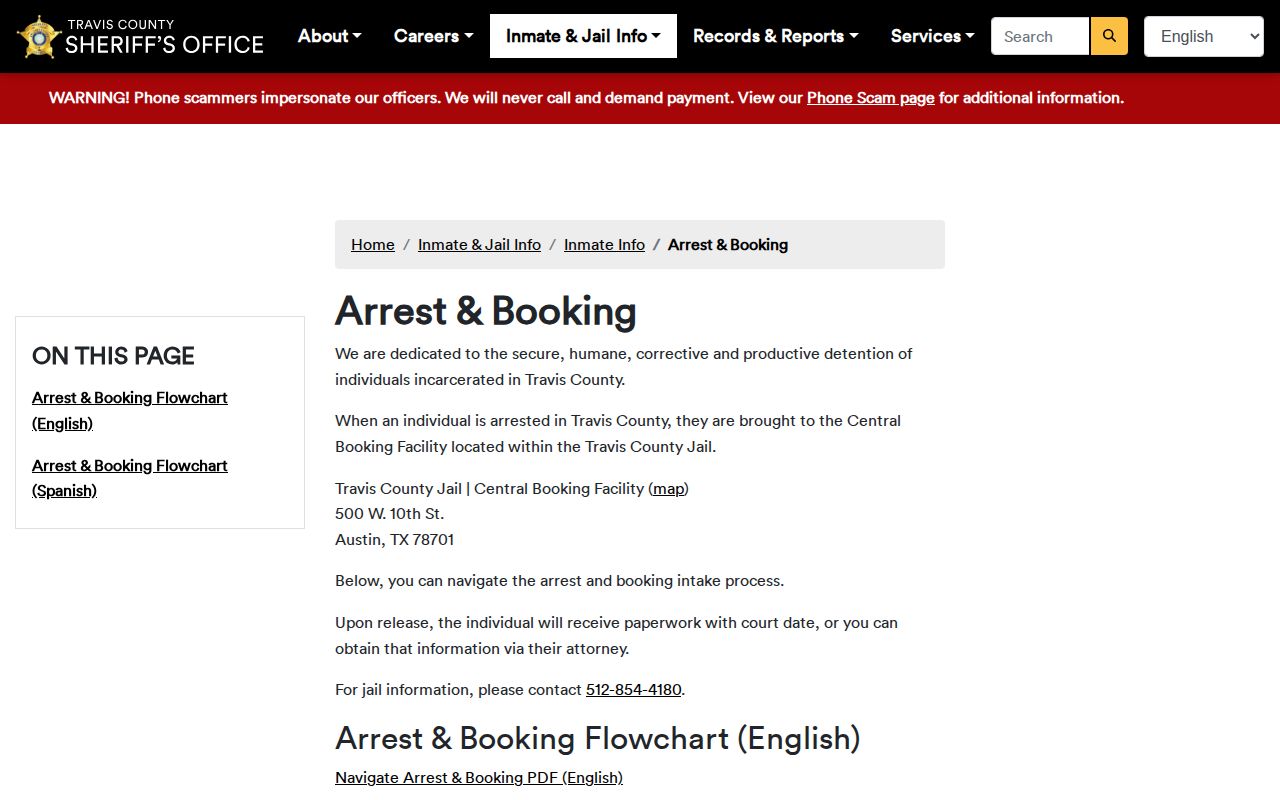
The screenshot supports the downtown facility's role in release processing. It does not supply a person's actual book-out time, which must come from the individual record.
The jail event and court case answer different questions. A signed bond or dismissal order shows why custody should change, while a final jail movement shows whether the person left and whether another authority took custody. One charge can resolve while another charge or hold keeps the booking active. That is why a charge-level disposition alone is not proof of physical release.
Property After an APD Arrest
TCSO separates valuables from release clothing. Its property instructions allow a person in custody to authorize the entire valuables bag or specified money to a designee who presents valid identification and the required form. Central Booking valuables may be released Sunday through Friday around the clock to help facilitate release, while other published windows differ by site and property type. Confirm the current window before making a trip.
A transfer to prison changes the practical task. TCSO advises designating a recipient for property and warns that unclaimed items can be discarded after 30 days. Property pickup does not prove release, and possession of clothing or valuables does not identify the legal disposition. It is a separate post-custody step that can continue after the person moves to TCCC or another authority.
Note: Facility plans and older master-plan descriptions do not establish that the currently published downtown booking facility has closed.
About APD Custody Records
Central Booking is at 500 West 10th Street in Austin. TCSO publishes 512-854-4180 for jail information. The neighboring court and pretrial buildings have their own counters and mailing addresses, so a court address should not be mistaken for the place where TCSO creates a book-out record. Felony case material belongs with the District Clerk, misdemeanor material with the County Clerk, and the custody event with TCSO.
Travis County Jail / Central Booking
500 W. 10th St.
Austin, TX 78701
Jail information: 512-854-4180
TCSO has not documented a rolling public 24-hour or 72-hour release feed or a fixed post-release web-retention period. For a near-term event, Texas VINE can provide a participating-agency custody-change notice, but an urgent or disputed result should still be checked with TCSO. For durable proof, the incarceration or open-records response is the better source.
APD Booking Photo Record
Austin maintains an official Booking Photo Database that is separate from TCSO's current-custody results. Research found that the APD database posts qualifying photos 13 days after arrest, can include other agencies that use Central Booking, and excludes juveniles. A photograph may also be withheld when law-enforcement interests require it. The database is useful for matching an arrest and booking number, but a photo does not establish that the person was released.
Search fields can include name, date of birth, booking number or date, and charges. Compare the arrest date and identifiers with the TCSO event. An APD image and a TCSO book-out are different records with different purposes and timing. If the arrest moved into county custody, ask TCSO for the final event and use the correct clerk for the court basis.
APD Court Record Routing
The court level depends on the case, not merely the APD label. City ordinance and Class C matters may remain with Austin Municipal Court. County misdemeanor cases are maintained by the Travis County Clerk, while felony cases are maintained by the District Clerk. The unified Odyssey portal can help locate the cause, but each clerk controls its own record set.
A bond or dismissal order supports the legal reason for release. It does not prove the physical event if another hold existed. Pair the court entry with APD confirmation when release occurred before county booking, or with the TCSO book-out when Central Booking accepted custody. Keep the source observation time separate from the event time.
APD Release Evidence Labels
Use a precise outcome. “Released by APD before county booking” needs an APD event or direct confirmation. “Booked into TCSO” means county custody began. “Transferred” means another authority took custody. When only a missing result exists, state that the person was not found in the system checked at that time.
Keep arrest, booking, book-out, and research times separate. Matching the APD incident, TCSO booking number, court cause, and receiving agency prevents an old arrest image from being mistaken for a fresh release.
APD's separate booking-photo database may preserve an arrest image after custody changes, but the photo is not a release field. Juvenile images are excluded, and publication can be withheld for law-enforcement interests. Use the photo only to reconcile the correct adult booking, then rely on the final custodian for release status.
No independent APD jail roster should be invented. If TCSO never accepted the person, request the city custody event and check the proper municipal court. If TCSO did accept the person, follow the county booking through its final movement.