
Federal Prison Release Scope
The Federal Bureau of Prisons is the custodian for many people serving federal sentences. It is not part of the Travis County Sheriff's Office, the Texas Department of Criminal Justice, or the Travis County court system. The facility sweep found no BOP institution within Travis County. This facility-map entry therefore refers to the nationwide BOP system, not a local prison building or a place where every federal detainee from Austin is held.
A person arrested in Travis County may pass through several distinct systems. TCSO may book a local or federal detainee. The U.S. Marshals Service may then assume custody for federal court proceedings and place the person in a contract jail. BOP custody usually becomes relevant after a federal sentence and designation. Each move closes one custody episode but does not necessarily return the person to the community.
Where Federal Prison Releases Go
A BOP release can mean the federal term of confinement ended, but it does not always mean all legal restraint ended. A person may enter federal supervised release, which is a court-ordered period in the community after imprisonment. Others may be delivered to another authority because of a state warrant, county hold, immigration action, or separate case. The BOP locator's release date answers when BOP custody ended for the displayed federal record, not whether every later or concurrent custody issue was cleared.
For a Travis County connection, compare the federal event with local chronology. A TCSO book-out that names a federal receiving agency is a transfer from county custody. It is not a community release. Conversely, a BOP record showing an older release date can be accurate even when a later TCSO search shows a new Travis County booking. The dates and named custodians resolve the apparent conflict.
| Federal result | What it supports | What to check next |
|---|---|---|
| Past date and “Released” | The person is no longer in BOP custody for that record. | Check later county, state, federal court, or immigration events if relevant. |
| Future release date | The date is projected, not a completed release. | Return to the locator for an actual status change. |
| “In Transit” | The person remains in a federal movement process. | Do not describe the movement as release. |
| “Unknown” | The confinement term is undetermined in the displayed record. | Use the federal docket and official inquiry routes. |
| No locator match | No universal custody conclusion follows. | Check identifiers, date coverage, USMS custody, and other systems. |
Confirm a Federal Prison Release
The official BOP Inmate Locator contains electronic information for federal inmates released after 1982. An identification-number search is the strongest starting point because it reduces errors between people with similar names. The locator accepts a BOP register number, DCDC number, FBI number, or former INS number. A name search can use age, race, and sex as filters.
- Choose an identifier search when a reliable federal number is available. Otherwise enter the recorded name and use the available demographic filters.
- Compare the result's register number, age, race, and sex with known case information. Do not rely on name alone.
- Read both the release date and the location or status wording. A past date paired with “Released” is the BOP's affirmative released-record signal.
- Check PACER for the federal court chronology when the locator result is unclear or supervision, sentencing, or a release order matters. PACER access and charges apply.
- Compare later events in the Travis County released-inmate search path if the person also had local custody. A later county event can supersede an older federal release for current-status purposes.
The BOP's official interpretation page gives needed context for the displayed labels. A release date is tied to BOP custody. It is not proof that federal supervised release ended, nor is it a statement about a later state or local hold. For records before 1982, the research directs users to the National Archives rather than promising locator coverage that does not exist.
Federal Release Locator Fields
The locator separates search inputs from result fields. Recording both helps preserve why a result was selected and what the federal source actually reported.
| Field | Use | Limit |
|---|---|---|
| BOP register number | Stable identifier for the federal record | Must match the correct individual |
| DCDC, FBI, or former INS number | Alternative identifier search | Coverage depends on the record |
| Name and demographic filters | Finds candidates without a number | Similar names require careful comparison |
| Release date | Shows a past event or future projection | Meaning depends on status wording |
| Location or status | Distinguishes released, transit, and unresolved terms | Does not describe every other custodian |
The official BOP locator screen shows the two search routes and the federal identifiers that may be used.
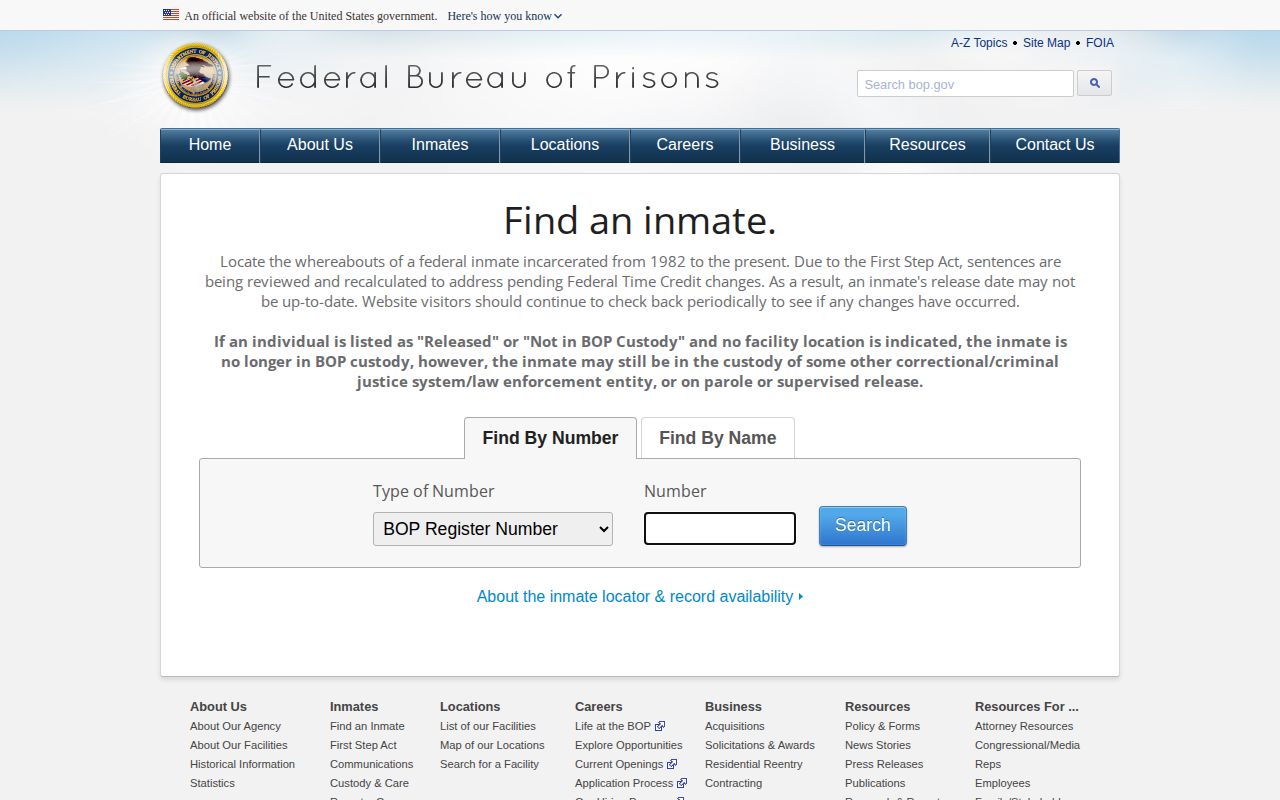
The captured screen confirms that the nationwide federal search is separate from the Travis County current-custody roster.
Read Federal Released Results
The BOP result should be quoted according to its own scope. “No longer in BOP custody” is precise when a past date and released location appear. “Free from all custody” is broader and may be false. Federal supervised release can follow prison, and another authority can take custody when the federal confinement term ends.
A projected date also requires restraint. It describes an expected federal event and may change. It is not proof that a person has left a BOP facility. “In Transit” identifies continued movement within federal handling. “Unknown” means the term is not determined in that display. These labels should never be converted into a guessed release date.
When a Travis County record and a federal result appear to disagree, compare the event dates before drawing a conclusion. A county book-out can precede federal admission, and a BOP release can precede a new local arrest. Both records may be accurate. Keep the register number, county booking number, source wording, and time checked with the result so each custody period remains tied to the right agency.
The BOP's released-record interpretation is shown below because it defines what the released location means.
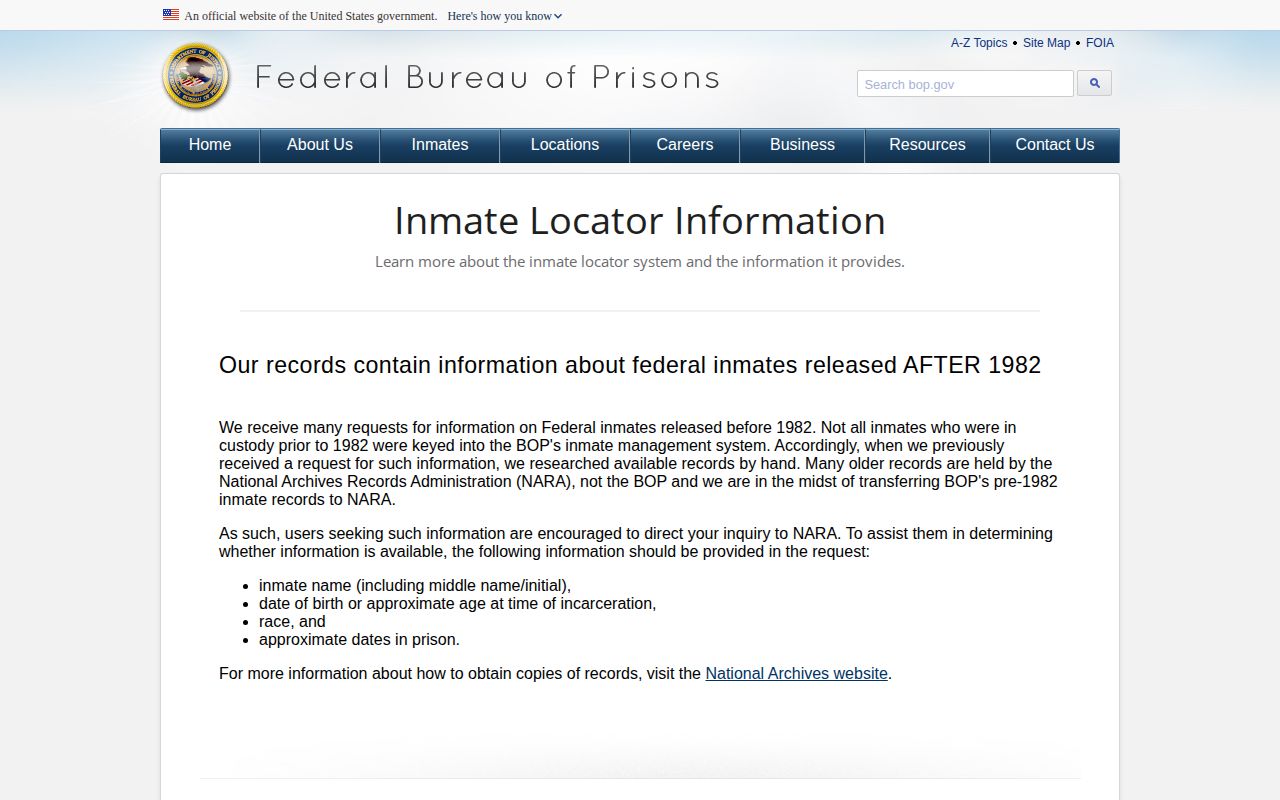
The explanation supports a narrow conclusion about BOP custody while leaving later custody and supervision to their own records.
Federal Prison Records and Contact
There is no Travis County BOP facility address to publish because the research found no BOP institution in the county. The appropriate contact point depends on the record. Use the locator for post-1982 electronic release information. Use the federal court docket for orders, sentencing, and supervision terms. Older federal prison records may require the National Archives. Questions about a person still managed before BOP designation belong with the U.S. Marshals Service rather than the BOP locator.
Federal Bureau of Prisons
Coverage: Federal prison facilities nationwide
Local facility: No BOP institution located in Travis County
Online record: BOP Inmate Locator
Older record route: National Archives for pre-1982 material
When asking for a record, identify the person with the most reliable federal number available, the relevant date range, and the specific existing document or event. Avoid asking an agency to create a narrative custody history. A precise request makes it easier to distinguish a BOP release date, a federal court order, and a later transfer.
Travis County Federal Custody Layers
A local booking and a federal sentence belong to different record chains. TCSO's current search covers people then in Travis County jail custody. A TCSO movement record can show transfer to USMS, while the federal docket explains the court basis. The BOP locator becomes the direct release source for a sentenced federal prisoner once that system has the record. Texas VINE and TDCJ searches do not replace the BOP route.
- Transfer
- A handoff from one custodian to another. Confinement continues.
- Projected release date
- A future estimate or scheduled date, not proof that release occurred.
- Federal supervised release
- Court-ordered community supervision that can follow federal imprisonment.
- Discharge
- The end of a sentence or supervision obligation, distinct from leaving prison under supervision.
If the trail stops before BOP admission, the U.S. Marshals Service custody page explains the pretrial and transport route. That distinction prevents a missing BOP result from being treated as evidence of release.